


On May 11, 1996, ValuJet Flight 592 departed Miami International Airport for what should have been an entirely forgettable flight to Atlanta.
Eleven minutes later, the aircraft was on fire.
Minutes after that, all 110 people aboard were dead.
Flight 592 crashed into the Florida Everglades northwest of Miami, disappearing into a landscape so remote and unforgiving that even recovering the aircraft and its victims became an extraordinary operation.
Today, along a lonely stretch of the Tamiami Trail, a small memorial marks one of the darkest chapters in American aviation history.
There are no museums here. No visitor center. No gift shop selling commemorative bullshit.
Just a monument, 110 names and miles of Everglades.
And that’s exactly how it should be.
DESTINATION: ValueJet 592 Memorial
GPS COORDINATES
25.7619, -80.6716
CLOSEST AIRPORT
CURRENT WEATHER
overcast clouds (79F / 26C)

AIR QUALITY INDEX (AQI)
Good (32)
VALUJET: WHEN CHEAP AIRFARE WAS THE ENTIRE BUSINESS PLAN
By the 1990s, the Golden Age of Aviation was long gone. The days of TWA, glamorous terminals and flying being an actual event, a world still beautifully preserved at New York’s TWA Hotel, had been replaced by an industry increasingly focused on competition, efficiency and cheap seats.
ValuJet arrived at exactly the right time.
Founded in 1993, the airline expanded rapidly with older McDonnell Douglas DC-9s and fares designed to get people from Point A to Point B without paying for any lingering fantasies about aviation glamour.
It worked.
But behind that rapid growth were increasing concerns about maintenance, contractor oversight and safety.
Then came May 11, 1996.
FLIGHT 592
ValuJet Flight 592 departed Miami International Airport at 2:04 PM carrying 105 passengers and five crew members.
Its destination was Atlanta.
Inside the aircraft’s forward cargo compartment were boxes containing chemical oxygen generators that had been removed from other aircraft.
If you’ve ever wondered where the oxygen comes from when those little masks dramatically fall from the ceiling during an emergency, chemical oxygen generators are part of the answer.
Once activated, they produce oxygen through a chemical reaction.
They also produce a tremendous amount of heat.
Which makes casually throwing improperly prepared generators into the cargo hold of a passenger aircraft a spectacularly terrible idea.
The generators should have been properly secured and protected against accidental activation.
They weren’t.
Investigators later determined that at least one activated after the aircraft departed Miami.
A fire began inside the cargo compartment.
And because the generators themselves produced oxygen, the fire had exactly what fires generally appreciate most.
More oxygen.
Within minutes, smoke entered the passenger cabin.
At 2:10 PM, the pilots reported an electrical problem and smoke in the cockpit and requested an immediate return to Miami.
Air traffic controllers cleared the aircraft back toward the airport.
They never made it.
THREE MINUTES THAT CHANGED EVERYTHING
The situation aboard Flight 592 deteriorated extraordinarily quickly.
The fire beneath the passenger cabin intensified. Critical flight-control systems were damaged. Smoke filled the aircraft.
The pilots struggled to maintain control while attempting to turn back toward Miami International Airport.
At approximately 2:13 PM, Flight 592 descended almost vertically into the Everglades.
The DC-9 struck the swamp at extremely high speed.
There were no survivors.
The aircraft essentially disappeared into the marsh.
Unlike crashes on solid ground, there wasn’t a recognizable fuselage surrounded by debris.
The Everglades absorbed much of it.
Aircraft wreckage, personal belongings and human remains were driven deep into the mud and limestone beneath the shallow water.
Investigators and recovery workers arrived to conditions that could hardly have been worse.
Heat.
Humidity.
Deep muck.
Sawgrass.
Mosquitoes.
Snakes.
Alligators.
And water that made simply determining where the aircraft ended and the Everglades began incredibly difficult.
Recovery operations continued for weeks.
Despite enormous efforts, many remains could never be individually identified.
The site itself became their final resting place.
THIS WASN’T JUST A FREAK ACCIDENT
The investigation into Flight 592 quickly moved beyond the fire itself.
The National Transportation Safety Board ultimately determined that the crash resulted from a chain of failures involving the handling and transportation of the oxygen generators.
The maintenance contractor SabreTech had improperly prepared the generators for shipment.
ValuJet failed to adequately oversee the contractor.
And the FAA was criticized for shortcomings in its oversight of both ValuJet and hazardous materials carried aboard aircraft.
In other words, there wasn’t one cartoon villain standing in a warehouse labeled GUY WHO CAUSED PLANE CRASH.
There was something considerably more disturbing.
A system in which multiple safeguards failed.
The oxygen generators shouldn’t have been improperly prepared.
They shouldn’t have been loaded aboard the aircraft in that condition.
ValuJet’s oversight should have caught the problem.
Regulatory oversight should have been stronger.
Any one of those layers working properly might have changed what happened.
None did.
WHAT HAPPENED TO VALUJET?
The consequences for ValuJet were immediate.
The airline was grounded by the FAA roughly a month after the crash and resumed limited operations later that year.
But the ValuJet name had become inseparable from Flight 592.
That’s generally problematic when your business model requires convincing people to voluntarily climb inside your airplanes.
In 1997, ValuJet acquired AirTran Airways.
The combined airline adopted the AirTran name.
ValuJet effectively disappeared.
AirTran eventually became a successful low-cost carrier before being acquired by Southwest Airlines, with the AirTran brand disappearing completely in 2014.
But Flight 592 changed aviation far beyond the corporate fate of one airline.
The disaster led to stronger requirements involving hazardous materials, cargo compartments, fire detection and suppression systems, and oversight of airline maintenance contractors.
Those changes came too late for 110 people.
But they helped make the aircraft flying today safer.
THE MEMORIAL IN THE MIDDLE OF NOWHERE
Three years after the crash, a memorial was dedicated near the accident site.
And when I say near, that word is doing some work.
The actual impact site is deep within the Everglades and isn’t somewhere you’re casually wandering over for a look.

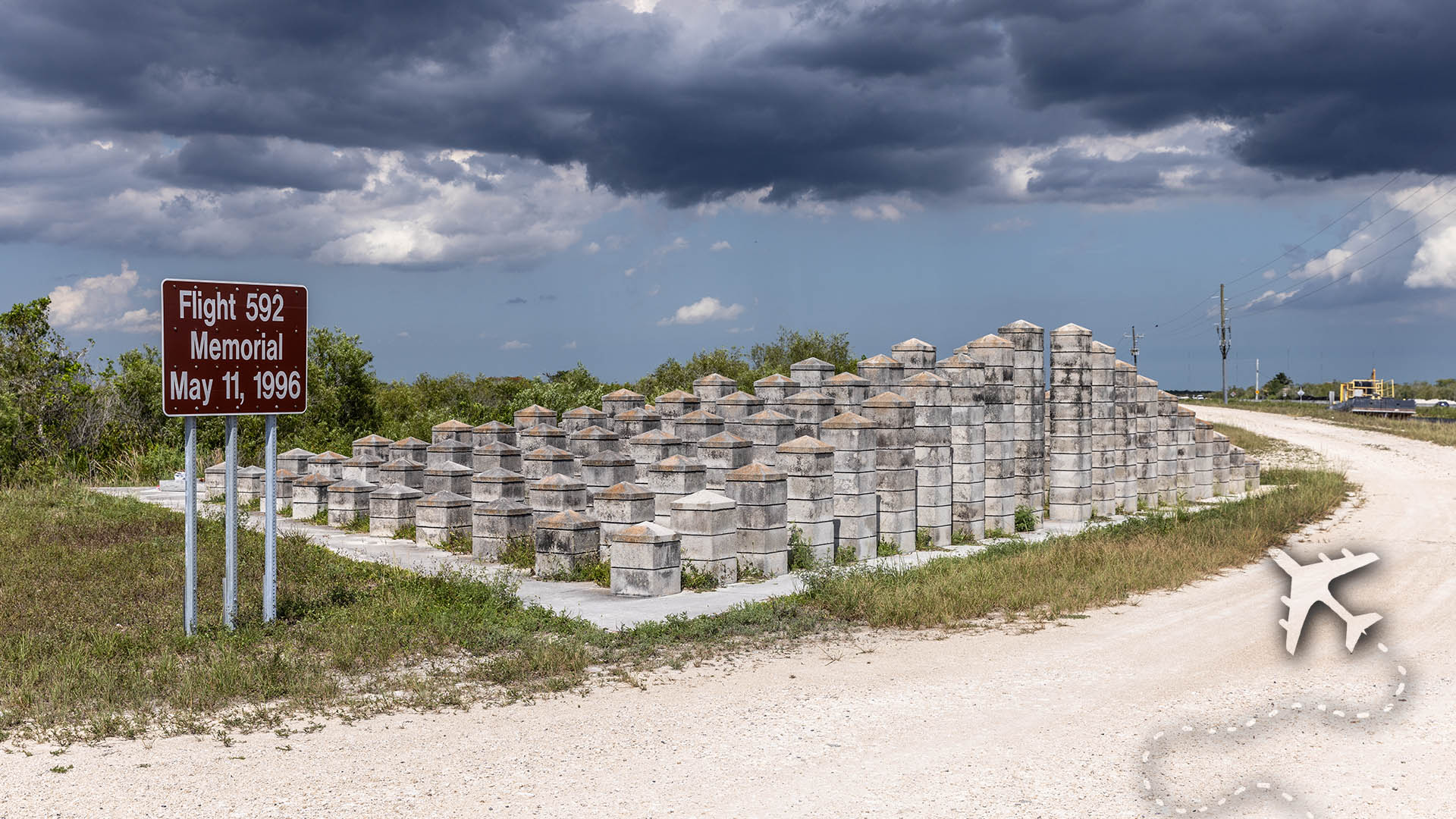
Instead, the memorial sits along an access road near Mile Marker 42 on the Tamiami Trail, west of Miami.
Even knowing it’s there, it’s remarkably easy to drive past.
Which feels appropriate.
This isn’t designed as a tourist attraction.
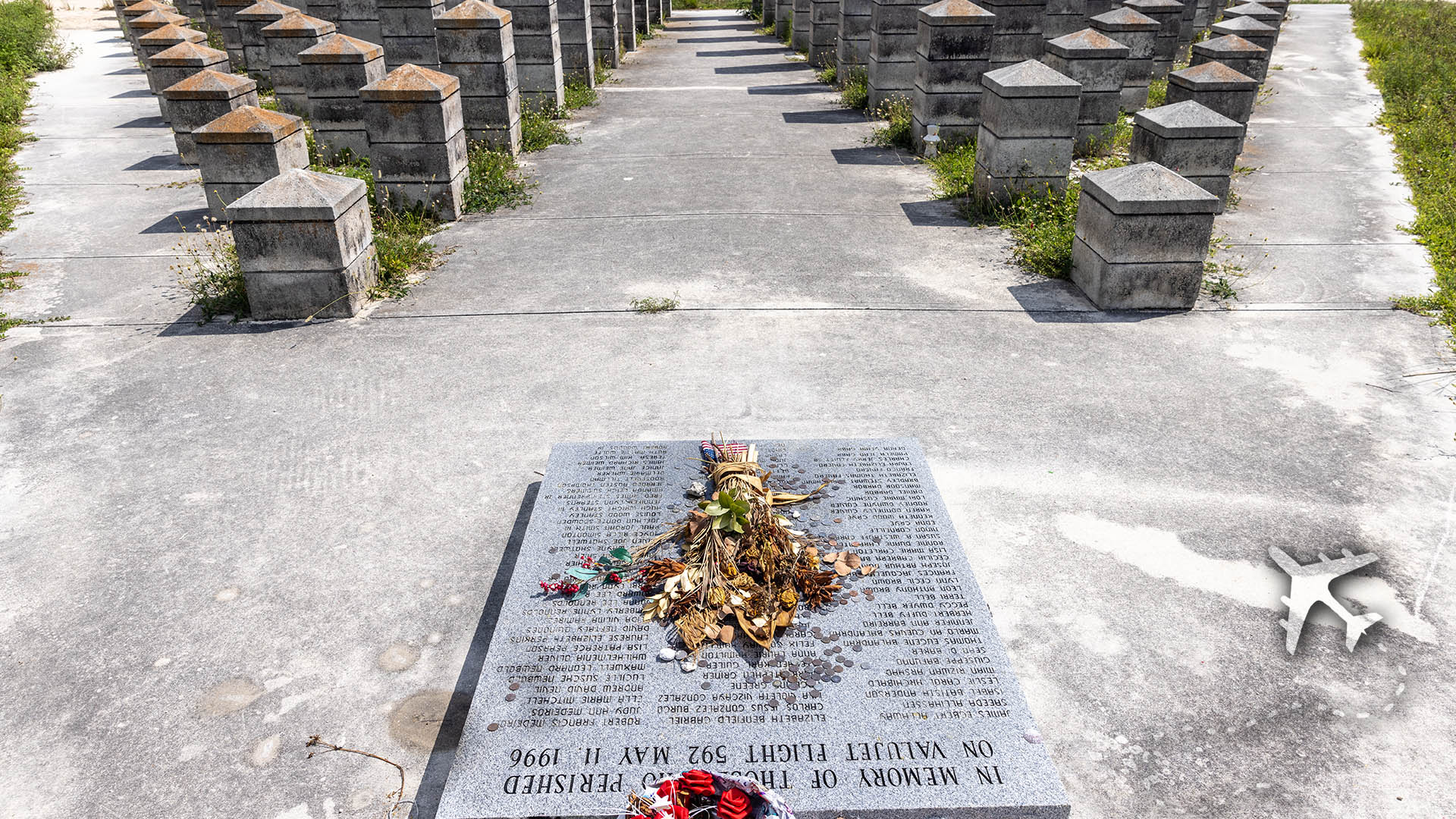
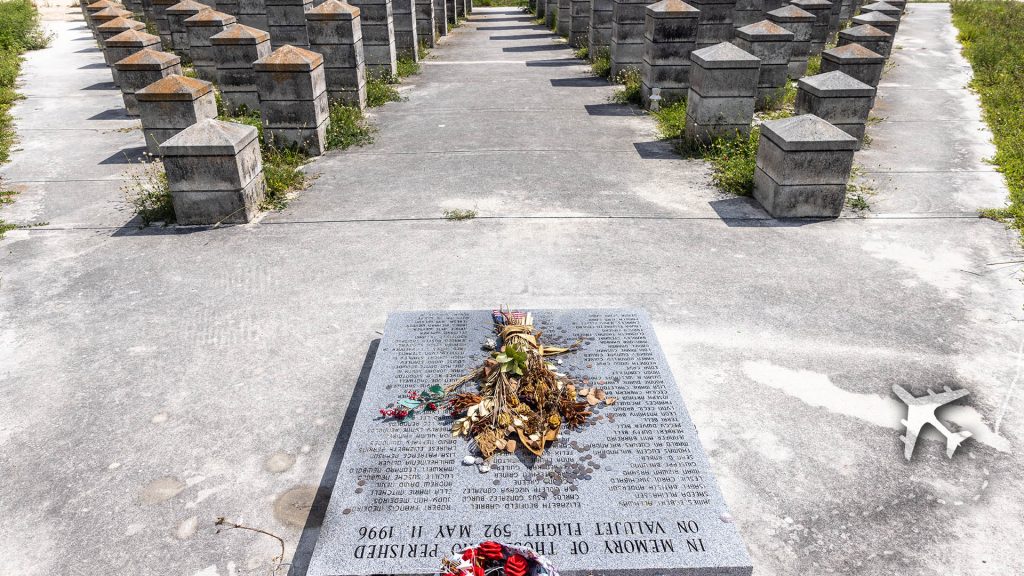
The memorial consists of concrete pillars arranged into a triangular form pointing toward the actual crash location.
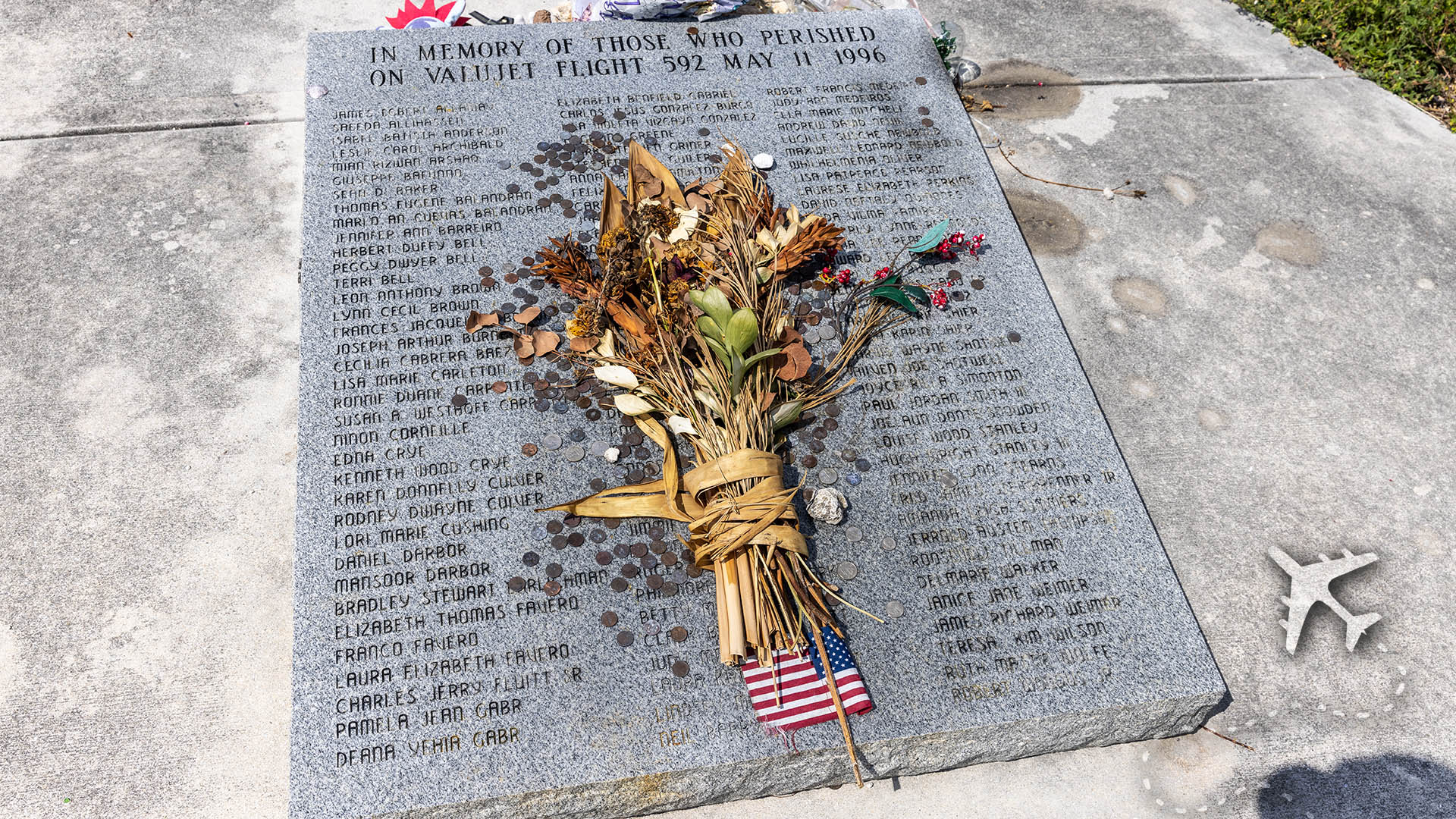
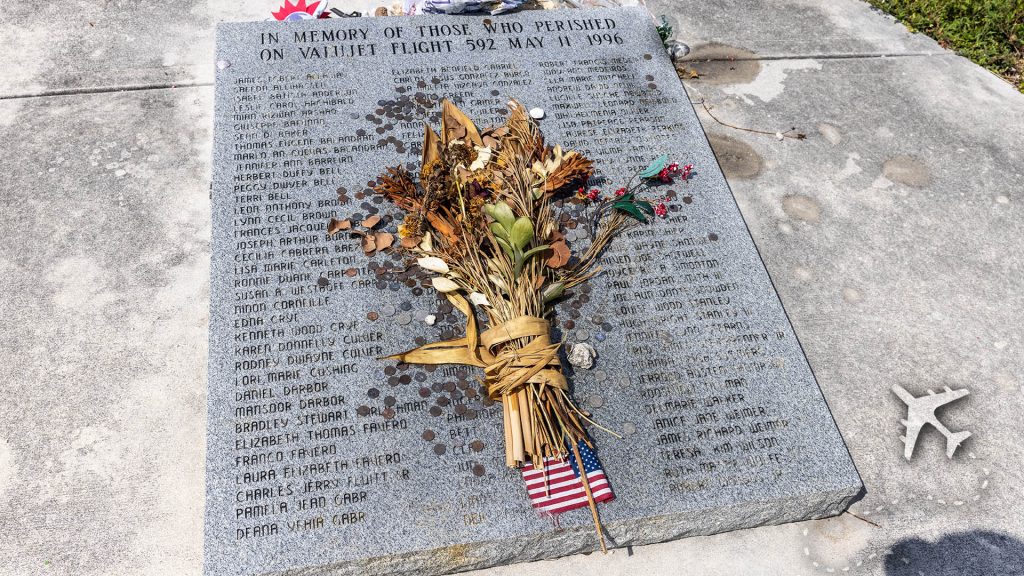
A plaque lists the names of all 110 people aboard Flight 592.
That’s basically it.
No elaborate exhibits.
No multimedia presentation.
No dramatic recreation of the accident.
Nothing attempting to turn tragedy into entertainment.
You’re standing beside a canal in the Everglades, surrounded by sawgrass, insects and an enormous amount of Florida wilderness.
The highway is nearby, but somehow the place feels isolated.
And then you start reading the names.
110 PEOPLE
Aviation disasters can become strangely mathematical over time.
Flight numbers.
Aircraft types.
Dates.
Accident reports.
Speeds.
Altitudes.
Timelines.
110 fatalities.
It’s easy to consume aviation history as statistics.
The memorial makes that considerably harder.
Every name carved into it represents someone who expected to arrive in Atlanta that afternoon.
People traveling for Mother’s Day weekend.
Families.
Business travelers.
Children.
Five crew members who went to work that morning expecting another routine flight.
Nobody boarded Flight 592 believing they were stepping into aviation history.
That’s one of the reasons places like this matter.
They turn statistics back into people.
DARK TOURISM WITHOUT THE SPECTACLE
I’ve visited plenty of dark tourism sites where the history is accompanied by museums, preserved ruins, photographs, artifacts and detailed exhibits explaining exactly what happened.
The ValuJet Flight 592 Memorial isn’t like that.
There isn’t much to do here.
And there shouldn’t be.
You park.
You walk over.
You read.
You think.
Then you probably stand there for a while staring across the Everglades toward a place you can’t actually see.
The landscape makes the experience stranger.
The Everglades are beautiful in their own distinctly Floridian way, an enormous horizon of sawgrass and water stretching seemingly forever.
But somewhere out there is the impact site.

Much of Flight 592 remains there.
So do remains of people who could never be recovered.
The Everglades didn’t simply become the location of the accident.
They became part of the story.
VISITING THE VALUJET 592 MEMORIAL
The memorial is located near Mile Marker 42 on US 41, the Tamiami Trail, approximately 40 miles west of Miami.
It’s near the L-67 canal and accessed from the north side of the highway.
Don’t expect enormous signs announcing:
CONGRATULATIONS, YOU HAVE ARRIVED AT ONE OF AMERICA’S WORST AVIATION DISASTERS.
This is intentionally understated.
If you’re driving between Miami and the western Everglades, it’s an easy stop to incorporate into the trip.
Just remember that you’re still in the Everglades.
Florida has spent millions of years perfecting an ecosystem seemingly designed to remind humans that we are soft, delicious and poorly adapted to humidity.
Bring water.
Bring sunscreen.
Bring insect repellent.
Then bring more insect repellent because the first application apparently just informs the mosquitoes that the buffet has opened.
But more importantly, treat the place appropriately.
This isn’t somewhere to climb on the monument for photographs or turn the memorial into another social-media backdrop.
Take photographs if you want.
Read the names.
Learn what happened.
Remember why the memorial exists.
VALUJET FLIGHT 592 MEMORIAL UNCENSORED
I grew up in South Florida, so ValuJet Flight 592 isn’t a disaster I discovered years later through dark tourism.
I remember it.
I vividly remember the news footage: helicopters hovering over the Everglades, recovery crews standing in the swamp and the almost incomprehensible realization that an airplane carrying 110 people had essentially disappeared into the sawgrass.
As I got older, I developed a serious love of travel. I’ve spent a ridiculous amount of my life on airplanes and wandering around the world, but I’ve never completely lost one simple realization:
Shit happens.
That’s why places like this matter.
Dark tourism shouldn’t just be about abandoned buildings, disasters and interesting photographs. Sometimes it should ground the shit out of you.
The 110 people aboard Flight 592 weren’t doing anything extraordinary. They were flying from Miami to Atlanta on a Saturday afternoon. They had families, plans and places they expected to be tomorrow.
Standing in the South Florida heat reading their names is a reminder that life isn’t guaranteed. Not in a depressing way, but as encouragement to be better stewards of the time we get.
Travel. Pay attention. Take the trip. Call the people who matter. Be decent to strangers.
Then get back in the car and continue wherever the hell you’re going.
And appreciate that you get to go there at all.


