


Taiwan had already given me plenty of city, food, traffic, neon signs and things I couldn’t identify being cooked on sticks.
But eventually I decided I should probably do something cultural.
You know, broaden my horizons.
Learn something.
Become a slightly more sophisticated human being.
Someone recommended Jiufen Old Street, an old mountain town northeast of Taipei packed with markets, teahouses, little shops and enough Taiwanese history to make it sound considerably more educational than whatever else I was probably planning to do.
“Just walk through Jiufen Old Street.”
Sounded easy enough.
So I went.
What nobody bothered mentioning was that Jiufen Old Street is less of a street and more of an endurance test with snacks.
DESTINATION: Jiufen Old Street
GPS COORDINATES
25.1099, 121.8452
CLOSEST AIRPORT
CURRENT WEATHER
scattered clouds (73F / 23C)

AIR QUALITY INDEX (AQI)
Air-quality data is currently unavailable.
THIS IS NOT A STREET
Calling this place “Old Street” feels intentionally misleading.
I was expecting a charming little stretch of shops. Maybe wander around for 30 minutes, photograph some lanterns, buy something unnecessary, eat something questionable and move on with my life.
Nope.
You enter through this relatively innocent-looking opening between buildings and suddenly disappear into what feels like an entire mountain constructed out of shops, food stalls, staircases, teahouses, souvenirs and humans.
And it just keeps going.
Every time I thought I had reached the end, Jiufen basically said: Cute. Keep walking.

Another alley appeared.
Then another staircase.
Then another collection of shops.
Then another crowd of people apparently purchasing enough snacks and souvenirs to personally sustain Taiwan’s GDP.
Jiufen is deceptively enormous.
THE WORLD’S LONGEST CULTURAL SHOPPING SPREE
Once I accepted that I wasn’t going anywhere anytime soon, I started enjoying the insanity.
Because Jiufen is actually really fucking cool.
The main pedestrian streets are narrow enough that you’re constantly weaving around people while vendors operate shops packed into buildings that look like they’ve been clinging to the mountainside since approximately the invention of gravity.
There’s food everywhere.
Tea everywhere.
Lanterns everywhere.
Souvenirs everywhere.
And approximately seventeen million people slowly shuffling along, buying snacks, souvenirs and mysterious bags of shit they couldn’t pronounce five minutes earlier but now absolutely fucking needed.
The whole thing is less of a sightseeing attraction and more of a giant cultural scavenger hunt where nobody actually knows what they’re looking for.
It reminded me a lot of wandering through Hanoi’s Old Quarter, where there isn’t necessarily one giant landmark you’re supposed to find, photograph and proudly declare “Yep, saw the thing.”
The chaos is the fucking attraction.
You walk.
You look.
You eat.
You occasionally get trapped behind someone moving at approximately three feet per fiscal quarter.
Then you keep walking.
FROM GOLD MINERS TO TOURISTS BUYING SNACKS
Jiufen wasn’t always a tourist destination.
The town exploded during Taiwan’s gold-mining era beginning in the late 1800s, when gold discoveries in the surrounding mountains brought miners, businesses and plenty of people hoping to get rich before everyone else got rich first.
Jiufen grew into an important mining community during Japanese rule over Taiwan, with houses, shops and teahouses spreading across the steep mountainside.
Then the mining industry declined.
As tends to happen when the thing your entire town is built around disappears, Jiufen declined with it.

For a while, this place became considerably quieter.
Eventually tourism discovered it.
And tourism apparently told everyone it knew.
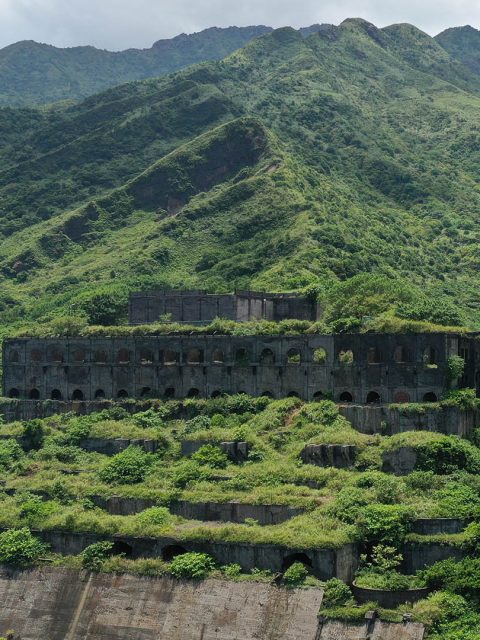
The same mining history also left behind some considerably stranger places nearby. If abandoned industrial shit is more your speed, the Ruins of Shuinandong Refinery are another leftover from the region’s mining era, except with substantially fewer souvenir shops and considerably more decaying concrete.
My kind of place.
THEN THERE ARE THE STAIRS
Jiufen was built into a mountain.
This becomes painfully obvious once you start exploring.
The famous images of Jiufen usually show red lanterns hanging above atmospheric little stairways lined with historic buildings and teahouses.
Beautiful.
Very Taiwan.
Extremely photogenic.
What the photographs conveniently leave out is the part where you have to walk up the fucking stairs.
There are staircases branching everywhere through Jiufen, connecting different levels of the town while reminding you that gravity remains fully operational in Taiwan.
Fortunately, they’re also where Jiufen starts looking especially cool.
Narrow passageways squeeze between old buildings. Red lanterns hang overhead. Teahouses seem stacked on top of each other. Every few minutes you’ll stumble into another opening with views across the mountains and toward the Pacific.
It’s chaotic, cramped and occasionally beautiful.
Basically, Jiufen rewards poor cardiovascular decisions with excellent photographs.
APPARENTLY EVERYONE ELSE HAD THE SAME IDEA
Jiufen isn’t exactly some undiscovered village where you’ll quietly wander ancient streets while contemplating Taiwanese history.
The secret is out.
Way the fuck out.
People come here in enormous numbers, especially during the middle of the day and on weekends.
At certain points, the narrow streets turn into a slow-moving human conveyor belt.
You aren’t really walking anymore.
You’re being transported through Jiufen by the collective momentum of several hundred tourists.
Stop suddenly and you’ll probably cause an international incident.
But strangely, the crowds didn’t ruin it for me.
They almost made sense.
Jiufen is a market town now. The noise, vendors, smells, people and complete lack of personal space are part of what makes the place interesting.
If you want silent historical reflection, there are probably better options.
If you want to dive headfirst into Taiwanese markets, food, architecture and organized pedestrian chaos, Jiufen delivers spectacularly.
YES, THERE’S FOOD
You could theoretically walk through Jiufen without eating anything.
You could also theoretically visit Paris without seeing the Eiffel Tower.
Nobody is stopping you from making terrible decisions.
Food stalls are wedged practically everywhere along Old Street, selling everything from dumplings and sausages to mochi, taro balls, tea and the infamous Taiwanese contribution to olfactory warfare: stinky tofu.

You will know when you’re getting close.
Your nose will notify you.
Taiwan’s street-food culture was already one of my favorite parts of wandering around Taipei City Center, and Jiufen basically takes that experience, compresses it into narrow mountain alleys and removes most opportunities for escape.
Hungry?
Excellent.
You came to the right place.
THE TEAHOUSES ARE RIDICULOUSLY PHOTOGENIC
Somewhere between the snack stalls and endless souvenir shops, Jiufen starts revealing the places responsible for most of those photographs you’ve probably seen online.
The teahouses.
Traditional buildings covered in glowing red lanterns cling to the hillside, sometimes with balconies overlooking the surrounding mountains and ocean.
The most famous is A-Mei Teahouse, which has become one of Jiufen’s unofficial visual trademarks.
There’s also a persistent internet legend that Jiufen inspired Hayao Miyazaki’s Spirited Away.
It apparently didn’t.
Miyazaki has denied the connection.
But that hasn’t stopped approximately the entire internet from continuing to say it anyway.
To be fair, wandering through Jiufen at night with the lanterns glowing and staircases disappearing between old buildings certainly looks like somewhere an animated spirit might steal your parents.
So I understand how we got here.
THIS WAS THE CULTURE’ISH THING I WAS LOOKING FOR
The more I wandered around Jiufen, the more I realized this was exactly what I’d been looking for.
Not because there was one spectacular landmark.
There isn’t.
Jiufen works because you’re experiencing an entire place.
The old buildings.
The markets.
The food.
The teahouses.
The staircases.
The history.
The ridiculous crowds.
The occasional view that suddenly appears between buildings and reminds you that you’ve somehow climbed halfway up a mountain while shopping.

I’ve visited plenty of cultural destinations where the experience revolves around standing in front of something historically important, taking twelve photographs and then leaving.
Jiufen isn’t really like that.
You explore it.
And apparently you keep exploring it because the fucking street refuses to end.
HOW MUCH TIME DO YOU ACTUALLY NEED?
More than I expected.
That was probably my biggest surprise.
I originally thought Jiufen would be a relatively quick stop.
Walk the street.
Look at some shops.
Take some pictures.
Mission accomplished.
Instead, there’s enough packed into the maze of streets and staircases that you can easily burn several hours here without really trying.
Especially if you’re photographing things.
Or eating.
Or shopping.
Or repeatedly stopping because another narrow alley covered in lanterns looks annoyingly photogenic.
You don’t necessarily need an entire day, but don’t treat Jiufen like a 30-minute roadside attraction.
This place is bigger than it looks.
Much bigger.
GO GET LOST IN JIUFEN
Jiufen Old Street turned out to be one of those places where my expectations were completely wrong in the best possible way.
I came looking for something vaguely cultural to do around Taiwan.
I expected a street.
Instead, I found an enormous maze of markets, food stalls, teahouses, staircases, lanterns and enough local shenanigans to keep me wandering around for hours.
It’s crowded.
It’s touristy.
It’s occasionally exhausting.
And yes, somewhere around staircase number 4,762 you’ll probably start wondering how the words “Old Street” failed to adequately prepare you for this.
But Jiufen is absolutely worth experiencing.
Come hungry.
Wear comfortable shoes.
Bring your camera.
And when you reach the point where you’re absolutely certain you’ve finally walked the entire thing…
Congratulations.
There’s probably another fucking staircase.