

Madakaripura Waterfall is one of those places where Indonesia briefly pretends you’re going on a pleasant little nature walk before gradually revealing that the actual itinerary involves rivers, slippery rocks, falling water and a complete surrender of anything resembling dry clothing.
Located in East Java near Bromo Tengger Semeru National Park, Madakaripura made perfect sense as a stop on my way toward Bromo. Java is a massive island with interesting shit scattered everywhere, and any opportunity to break up several hours of driving with a 200-meter waterfall seemed like a reasonably good idea.
At least that’s how it looked on the map.
What the map doesn’t adequately communicate is that Madakaripura isn’t really a waterfall you simply visit.
You have to go find the bastard.
And apparently get completely soaked in the process.
DESTINATION: Madakaripura Waterfall
GPS COORDINATES
-7.8477, 113.0161
CLOSEST AIRPORT
CURRENT WEATHER
overcast clouds (79F / 26C)

AIR QUALITY INDEX (AQI)
Moderate (63)
WELCOME! SOME OF YOU SHOULD PROBABLY LEAVE
Madakaripura begins with an impressive commitment to tourism marketing.
There’s a giant fucking sign welcoming you to Madakaripura Waterfall, because apparently you’ve officially arrived in the wilderness when somebody erects letters large enough to be visible from low Earth orbit.

It’s enormous.
It’s cheerful.
It’s practically screaming:
WELCOME TO MADAKARIPURA! YOU’RE GOING TO HAVE A WONDERFUL TIME!
Naturally, this is where everyone stops for photographs.
But nearby are several considerably smaller signs containing information that arguably deserves slightly more attention.

Pregnant people? Not allowed.
Babies? Nope.
Elderly visitors? Apparently Grandma’s waterfall adventure ends here.
I appreciated the hierarchy. The enormous sign announces that you’ve arrived at one of East Java’s most spectacular natural attractions. The tiny signs quietly explain that certain members of your family might die trying to reach it.
It’s almost like somebody from tourism looked at the warnings and decided WELCOME TO MADAKARIPURA: PLEASE DON’T BRING ANYONE PARTICULARLY FRAGILE wasn’t going to move enough tickets.
At first, the restrictions seem slightly dramatic.
Then you start walking.
THE SUSPICIOUSLY EASY BEGINNING
The first part of the journey does absolutely nothing to justify those warning signs.
The trail follows a river through dense tropical vegetation with enormous green cliffs rising on either side. It’s humid as hell, but the path is relatively easy and the scenery is spectacular.
For about 30 minutes, Madakaripura allows you to believe you’ve discovered some wonderfully accessible jungle waterfall.

You stroll.
You take photographs.
You admire the vegetation.
You begin questioning whether the warning signs were written by lawyers who consider walking across a wet kitchen floor an extreme sport.
Then the canyon starts getting narrower.
The cliffs get taller.
The trail gets wetter.
And Madakaripura slowly stops pretending.
EVENTUALLY, THE RIVER BECOMES THE TRAIL
The deeper you travel into the canyon, the less distinction there is between hiking alongside the river and hiking directly through it.
The nice comfortable path begins disappearing beneath rocks and shallow water. You’re stepping between stones, crossing streams and carefully negotiating increasingly slippery terrain while the canyon walls close in around you.
Suddenly those little warning signs back at the entrance don’t seem quite so ridiculous.
The trail eventually funnels into a narrow opening between towering cliffs.
And that’s where the water starts attacking from above.
Madakaripura’s main waterfall might be the headline attraction, but apparently the surrounding canyon walls didn’t get the memo.
Water pours down from everywhere.
Small cascades spill from the cliffs. Streams tumble across the rock walls. Mist fills the canyon. Water drips from vegetation overhead.
You haven’t even reached the waterfall yet and the waterfall has somehow already reached you.
WELCOME TO INDONESIA’S NATURAL CAR WASH
This is also where ponchos suddenly become extremely popular.
Visitors start wrapping themselves in plastic while attempting to protect phones, wallets, cameras and whatever other possessions they optimistically assumed would remain dry.
Everyone looks like they’re wearing brightly colored garbage bags.
You can buy or rent rain protection before entering the canyon, which should probably have been another clue about what was coming.
I had camera equipment.
Expensive camera equipment.
Equipment containing electronics.
Electronics traditionally having a somewhat complicated relationship with waterfalls.
So naturally I continued.
The route requires walking directly beneath several cascades spilling from the canyon walls. There isn’t some secret dry route around them.
You just walk through.
At first, you attempt to dodge the water.
Then you attempt to move quickly through the water.
Then you realize this is completely fucking pointless and accept that Madakaripura owns your clothing now.
Shoes get soaked.
Pants get soaked.
Your shirt gets soaked.
Eventually you’re wet enough that stepping into another stream doesn’t even register anymore.
This is strangely liberating.
Once you’ve accepted that you’re going to spend the rest of the day marinating in your own clothing, the experience becomes significantly more enjoyable.
THEN THE CANYON OPENS
After squeezing through the narrow canyon and getting repeatedly pressure-washed by nature, you finally reach the main attraction.
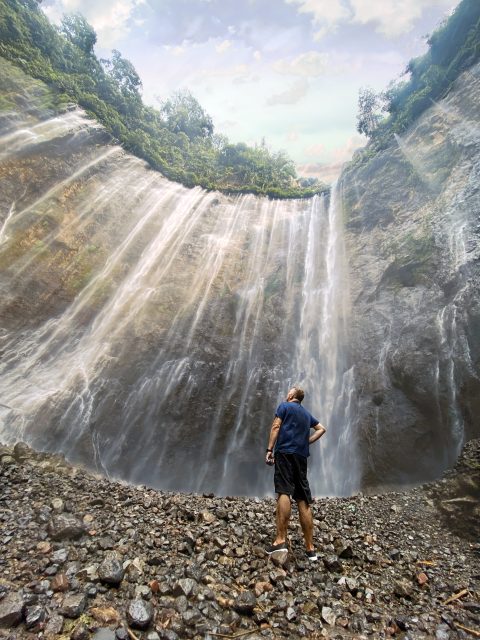
Madakaripura Waterfall drops roughly 200 meters from the cliffs above into a massive natural chamber surrounded by nearly vertical walls.
And it’s fucking spectacular.

The waterfall plunges from what feels like an impossible height, disappearing into clouds of mist before crashing into the rocks and pool below.
The surrounding cliffs are covered with moss and vegetation, creating an enormous green amphitheater with only a narrow opening toward the sky.
Everything feels oversized.
The cliffs.
The waterfall.
The sound.
The amount of water currently inside your shoes.
Standing at the bottom feels less like visiting a tourist attraction and more like accidentally wandering into some prehistoric geological cathedral.
It’s the kind of place where you half expect a dinosaur to walk around the corner.
Although knowing Indonesia, somebody would immediately put a ticket booth next to it.
OF COURSE, EVERYONE NEEDS THE PHOTO
Madakaripura has all the ingredients required to become extremely popular on social media.
Giant waterfall.
Dramatic cliffs.
Tropical jungle.
Mysterious mist.
Tiny humans standing dramatically beneath enormous nature.
Which means everyone wants the photo.
You know the one.
One person stands on a rock staring contemplatively toward the waterfall while the photograph conveniently suggests they’ve discovered an untouched corner of the planet completely alone.
Meanwhile, just outside the frame, dozens of other people are standing around in ponchos waiting for their turn to look equally contemplative.
Nothing says solitary communion with nature quite like a queue for Instagram.
Fortunately, Madakaripura is big enough that the crowds don’t completely ruin it. The canyon is enormous, the waterfall dominates everything and there’s plenty to explore once you reach the main chamber.
Just don’t expect to have the place to yourself.
The secret is very much out.
GAJAH MADA WAS HERE BEFORE WATERFALLS NEEDED HASHTAGS
Long before tourists started wandering into East Java’s waterfalls carrying GoPros, drones and enough camera equipment to film the next Planet Earth, Madakaripura already had a pretty good story.
The waterfall is closely associated with Gajah Mada, the legendary 14th-century prime minister of the Majapahit Empire and one of the most important figures in Indonesian history.
Gajah Mada helped expand Majapahit influence across much of the Indonesian archipelago, which was considerably more impressive than my accomplishment of successfully reaching the waterfall without destroying a camera.
According to local legend, Madakaripura became his final meditation place, with the name commonly interpreted as “the last place of Mada.”
Whether Gajah Mada actually disappeared into this particular canyon for his final days is difficult to prove roughly 700 years later.
But standing inside Madakaripura, the story doesn’t exactly require a massive suspension of disbelief.
The place feels isolated today.
Imagine trying to reach it in the 14th century.
No Google Maps.
No motorcycles.
No maintained trail.
No Gore-Tex.
No guy selling emergency ponchos because tourists just discovered their $14 Amazon backpack isn’t waterproof.
Just jungle, enormous cliffs and a river disappearing into a canyon.
If Gajah Mada wanted somewhere to get away from people, he absolutely nailed it.
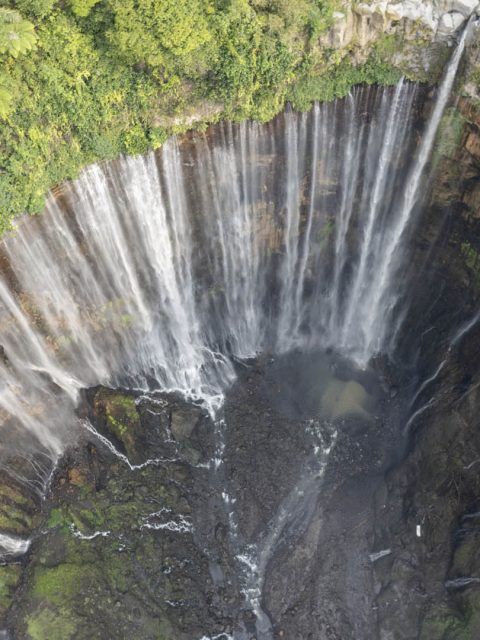
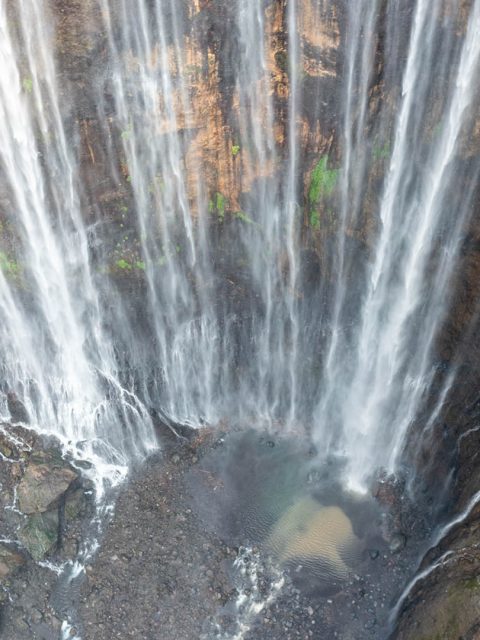
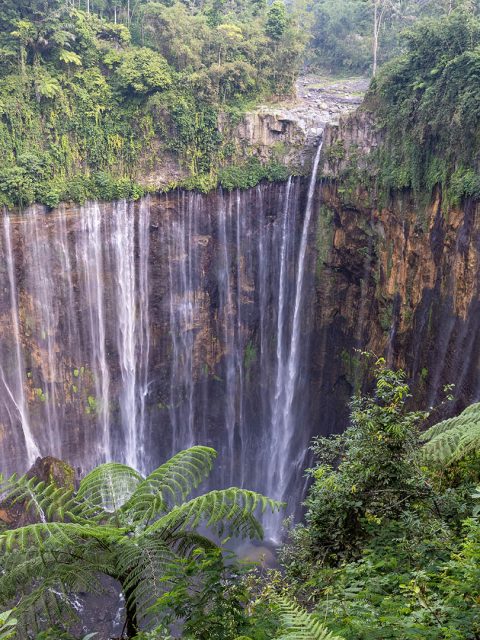
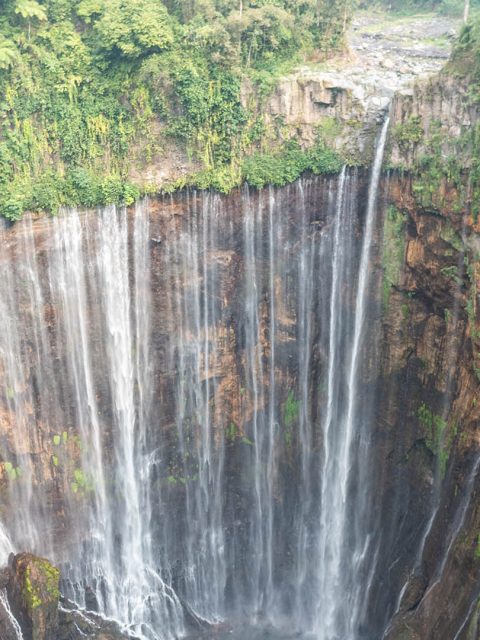
It’s also part of what makes Madakaripura so different from Tumpak Sewu Waterfall, another of East Java’s spectacular waterfalls. Tumpak Sewu overwhelms you with sheer scale, with countless streams of water pouring into an enormous jungle amphitheater beneath Mount Semeru. Madakaripura feels almost claustrophobic by comparison, pulling you deeper into an increasingly narrow canyon until you’re practically surrounded by falling water.
Both should be on any serious East Java waterfall itinerary, but they’re completely different experiences.
Tumpak Sewu basically screams LOOK AT ME.
Madakaripura quietly invites you into a canyon and then attempts to drown your shoes.
PHOTOGRAPHING MADAKARIPURA IS A PAIN IN THE ASS
If you’re traveling around East Java specifically for photography, Madakaripura and Tumpak Sewu are two waterfalls you’ll probably want on the itinerary.
They’ll also find completely different ways to make you hate your camera equipment.
At Tumpak Sewu, the challenge is capturing the ridiculous scale of the place. You’re trying to squeeze an enormous semicircular curtain of waterfalls, dense jungle and, if the weather cooperates, Mount Semeru into something resembling a photograph.
Madakaripura has another strategy.
It just throws water at you.
The canyon is dark. The sky above it is bright. Mist hangs everywhere. Water pours from the surrounding cliffs and droplets continuously appear on your lens approximately four milliseconds after you’ve cleaned it.
Wipe lens.
Compose photograph.
Water droplet.
Wipe lens.
Adjust exposure.
Different water droplet.
Wipe lens.
Take photograph.
Discover giant blurry blob directly in the middle.
Question your life choices.
Repeat.
A wide-angle lens is extremely useful because you’re standing inside a narrow canyon surrounded by enormous vertical cliffs. Unlike the sprawling panorama at Tumpak Sewu, Madakaripura forces you to photograph upward and outward from relatively close range.
Long exposures can make the falling water look incredible, assuming you can find somewhere reasonably stable for a tripod among wet rocks, flowing water and other tourists attempting exactly the same thing.
Then there’s the slightly more important matter of keeping several thousand dollars of electronics alive.
Bring genuinely waterproof protection for your camera gear.
Not water resistant.
Not weather resistant.
And definitely not some backpack whose marketing department established its waterproof credentials by photographing it next to a puddle.
Waterproof.
Because Madakaripura doesn’t give a shit what the little tag on your backpack says.
It will happily conduct its own independent laboratory testing.
MADAKARIPURA IS WORTH GETTING WET
Madakaripura turned out to be considerably more interesting than the convenient waterfall stop I originally expected.
The giant welcome sign makes it look like another organized tourist attraction.
The tiny warning signs suggest otherwise.
The first section of trail convinces you they’re exaggerating.
Then the trail disappears into the river.
Then the canyon closes around you.
Then waterfalls start pouring directly onto your head.
And finally, after you’ve completely abandoned the concept of dry clothing, Madakaripura reveals this enormous hidden amphitheater buried inside the East Java jungle.
That’s what makes the place memorable.
You don’t simply stand at an observation platform looking at Madakaripura from a safe distance.
You walk into it.
You climb across its rocks.
You wade through its river.
You walk underneath its waterfalls.
You get absolutely fucking soaked.
And somewhere along the way, you finally understand why the giant sign at the entrance says WELCOME, while the much smaller signs quietly suggest that Grandma might want to wait in the car.