

Another fucking National Geographic magazine.
That was apparently all it took.
Long before Instagram started convincing adults to fly halfway around the planet because someone photographed a swimming pool from a flattering angle, National Geographic was quietly destroying my future financial responsibility one spectacular photograph at a time.
Volcanoes. Shipwrecks. Remote islands. Weird animals. Places that looked like they required three airplanes, a boat, questionable vaccinations and absolutely no common sense to reach.
I ate that shit up.
And somewhere along the way, I became completely obsessed with the Galapagos Islands.
Note to adult self: Why the fuck was young Sean spending so much time looking at National Geographic instead of Playboy?
This feels like a developmental anomaly worthy of further investigation.
But eventually childhood curiosity collided with adult money.
And adult money is dangerous.
Because adult money can buy airline tickets.
So I did.
DESTINATION: GALAPAGOS TORTOISES
GPS COORDINATES
-0.6704, -90.4307
CLOSEST AIRPORT
CURRENT WEATHER
broken clouds (79F / 26C)

AIR QUALITY INDEX (AQI)
Good (17)
NATIONAL GEOGRAPHIC HAS CONSEQUENCES
The Galapagos had been sitting on my imaginary travel list for years, but one animal had always fascinated me more than almost everything else crawling, swimming or flying around these ridiculously isolated islands.
The Galapagos giant tortoise.
These things looked prehistoric.
Not prehistoric-inspired.
Not “sort of dinosaur-ish.”
They looked like someone forgot to tell them the dinosaurs were gone and they should probably update the software.
Huge shells. Wrinkled necks. Giant feet. Faces permanently expressing mild disappointment with humanity.
I needed to see one.
Then my research uncovered something considerably less entertaining.
Humans had nearly wiped them out.
Well, fuck.
WE ALMOST FUCKED THIS UP
Before people arrived and began doing what people historically do best to isolated ecosystems, Galapagos tortoises had essentially won the evolutionary lottery.
Food everywhere.
Very few things interested in eating them.
No mortgage.
No commute.
No fucking meetings.
Life was good.
Historical estimates suggest there may once have been hundreds of thousands of giant tortoises throughout the Galapagos Islands.
Then humans arrived.
Sailors and settlers discovered that an enormous, extremely slow-moving animal was not particularly difficult to catch.
Shocking development.
Tortoises were collected for food, while introduced animals including goats, pigs, rats and other invasive species damaged their habitat, competed for food or preyed on eggs and young tortoises.
Populations collapsed.
By the 1970s, only a fraction of the original Galapagos giant tortoise population remained.
Suddenly my childhood National Geographic obsession wasn’t just about seeing a gigantic reptile.
I wanted to see an animal humanity had come dangerously close to turning into another museum exhibit.
WELCOME TO SANTA CRUZ: PLEASE WATCH FOR DINOSAURS
I landed on Santa Cruz Island, eventually made my way toward Puerto Ayora and began exploring.
One of the stranger things about Santa Cruz is how dramatically the landscape changes as you travel across it.
The lower elevations can look dry, rocky and aggressively volcanic.
Head into the highlands and everything turns green.
Really green.
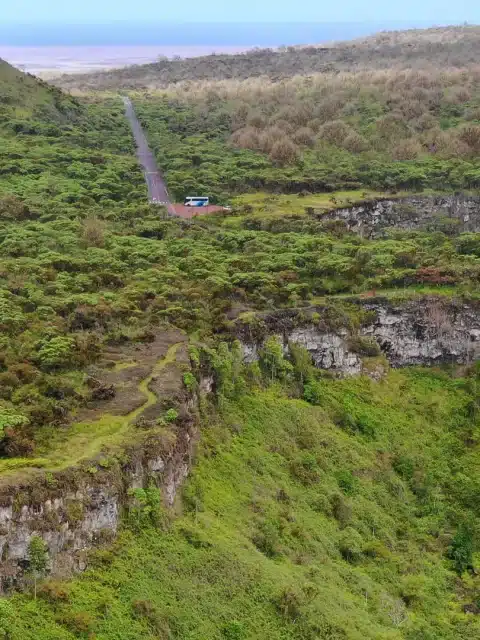
If you’re crossing Santa Cruz anyway, stop at Los Gemelos, where you can walk around two enormous collapse pits surrounded by lush vegetation and confidently tell everyone you visited one of the Galapagos’ famous geological attractions.
They’re holes.
Very impressive holes.
But I had more important wildlife to locate.
I was going looking for the world’s most awkward lawn mowers.
RANCHO PRIMICIAS: JURASSIC PARK AT 0.3 MPH
One of the easiest places to see Galapagos giant tortoises in their natural habitat on Santa Cruz is Rancho Primicias.
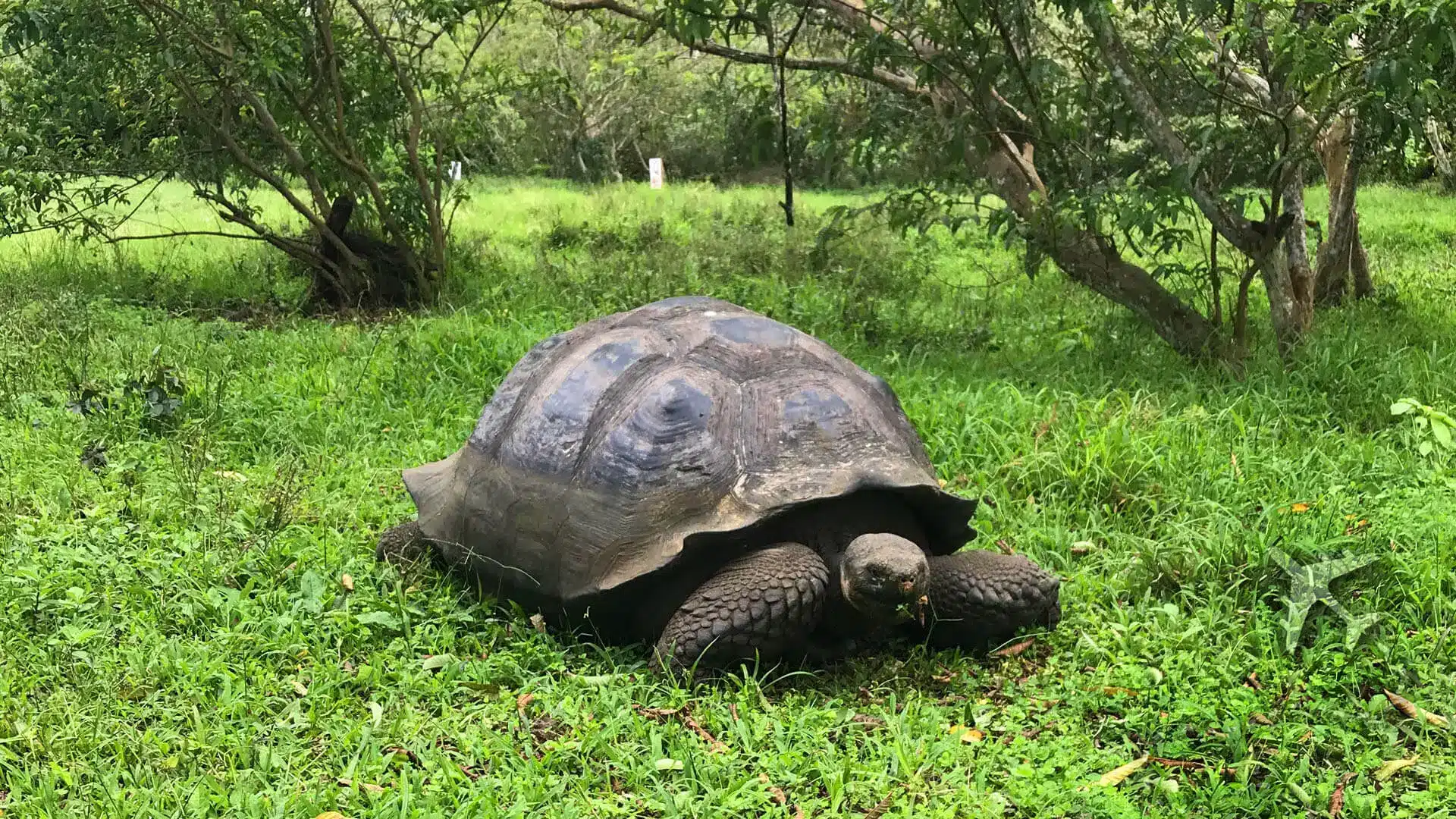
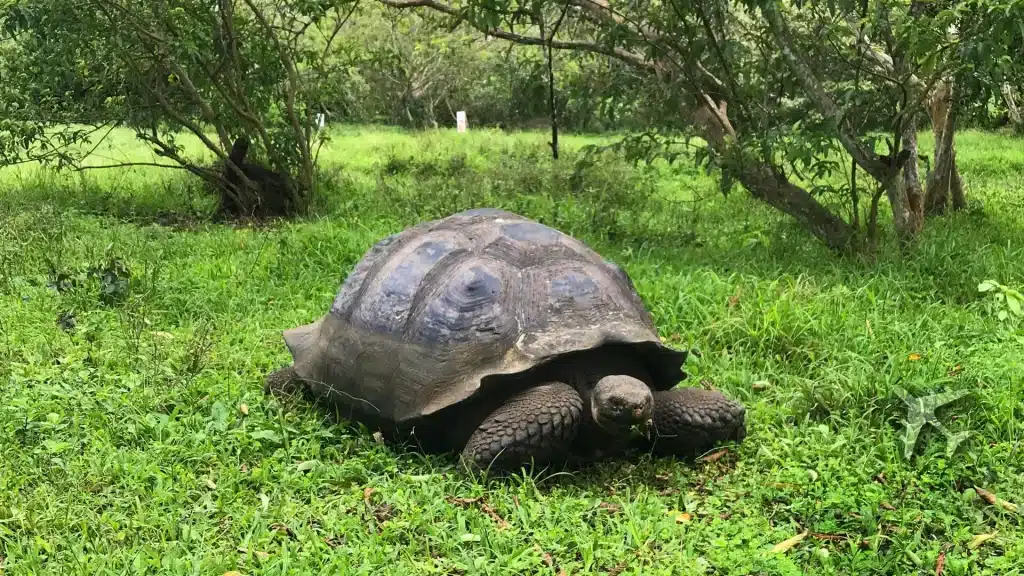
The private reserve sits in the lush highlands, where giant tortoises wander through fields, graze and generally conduct their daily business without appearing remotely concerned about your vacation.
And unlike a zoo, they’re not sitting inside some carefully decorated enclosure waiting for someone to throw lettuce at them.
They’re just… there.

Walking around.
Eating grass.
Sitting in mud.
Pooping.
Walking another six feet.
Eating more grass.
Pooping again.
It is possibly the least energetic wildlife encounter imaginable.
And I fucking loved it.
BEHOLD THE GALAPAGOS TORTOISE IN ITS NATURAL HABITAT
Photographs don’t adequately communicate how substantial these things are.
Some Galapagos giant tortoises can weigh several hundred pounds.
Standing near one feels less like looking at a turtle and more like someone put legs underneath a decorative landscaping boulder.
Then the boulder starts eating.
Their Galapagos tortoise habitat varies by island and species, but on Santa Cruz, many migrate between the humid highlands and lower, drier areas depending on food availability, rainfall and breeding cycles.
Which means you don’t necessarily need Rancho Primicias to see them.
You may find giant tortoises wandering through fields.

Beside roads.
Across roads.
Possibly creating the slowest traffic jam in Ecuador.
And yes, you wait.
Because if a giant tortoise decides the road belongs to him, the road belongs to him now.
He’s been here longer than you.
ARE GALAPAGOS TORTOISES FRIENDLY?
Are Galapagos tortoises friendly is a supringly popular question.
Define friendly.
They’re not golden retrievers.
They’re also not roaming Santa Cruz hunting tourists.
Galapagos giant tortoises are generally docile herbivores whose daily ambitions revolve heavily around eating vegetation, resting, reproducing and moving somewhere else extraordinarily slowly.
If you approach too closely, they’re far more likely to retreat into their shell than launch some sort of high-speed tortoise counterattack.

Which is why you should give them space.
Don’t touch them.
Don’t feed them.
Don’t climb onto one because your Instagram account desperately needs validation.
Observe.
Take pictures.
Allow the enormous prehistoric lawn mower to continue mowing.
WHAT EATS A GIANT TORTOISE?
Adult Galapagos tortoises historically had very few natural predators, which helps explain how these lumbering tanks evolved successfully on isolated islands.
Once fully grown, being enormous and carrying your own armored bunker around is a reasonably effective survival strategy.
Young tortoises and eggs are considerably more vulnerable.
Introduced species such as rats, pigs and dogs created serious problems by eating eggs and juveniles, while goats and other invasive animals competed for vegetation and wrecked tortoise habitat.
So when people search “what eats Galapagos tortoises?”, the unfortunate answer is basically: Not much naturally.
Then humans showed up and complicated everything.
We have a gift.
THESE THINGS MAY OUTLIVE YOU
Another reason giant tortoises fascinated me as a kid was their lifespan.
A Galapagos tortoise lifespan can exceed 100 years, and some individuals can live considerably longer.
Think about that.
A tortoise wandering around Santa Cruz today could have been eating grass before commercial aviation existed.

It watched humanity invent television.
Jet airplanes.
The internet.
Social media.
Influencers.
And after observing all of that progress, it apparently decided the correct response was to continue eating grass.
Smartest animal on the island.
Their extremely long lifespan also makes conservation painfully slow.
You don’t rebuild populations of animals that mature slowly and can live for more than a century over a couple of breeding seasons.
Protecting Galapagos giant tortoises is a generational project.
Fortunately, conservation programs throughout the islands have made significant progress restoring populations that once looked absolutely fucked.
AND THEN THERE WAS LONESOME GEORGE
The story gets considerably sadder when you visit the Charles Darwin Research Station in Puerto Ayora.
That’s where you’ll find Lonesome George.
George was the last known Pinta Island tortoise.
Conservationists spent years trying to breed him, hoping there might be some way to preserve his genetic line.
George apparently had other plans.
He died in 2012.
And with him disappeared the last known pure representative of the Pinta Island giant tortoise lineage.
His preserved body is now displayed at the Charles Darwin Research Station.
It’s difficult to stand there looking at him without understanding exactly what “extinction” means.
It isn’t an abstract conservation statistic.
There isn’t another one hiding somewhere behind the exhibit.
That’s it.
Humanity had hundreds of thousands of giant tortoises spread across the Galapagos.
And in at least one case, we eventually got the number all the way down to zero.
Excellent work, everyone.
MEANWHILE, BACK AT THE TORTOISE SHIT FACTORY
Rancho Primicias is considerably less depressing.
Because there are tortoises everywhere.
And where there are enormous grass-eating reptiles…
There is poop.
So. Much. Tortoise. Poop.
This apparently generates enough curiosity that people genuinely search Google for “giant tortoise poop.”

The internet remains undefeated.
For scientific purposes, I can confirm that giant tortoises eat vegetation, vegetation eventually completes its journey through the tortoise, and the resulting biological product is distributed liberally throughout the grass.
Watch where you step.
Trust me.
Nothing completes your magical childhood dream of encountering a Galapagos giant tortoise quite like realizing you’ve just planted your shoe into something that came out of one.
National Geographic conveniently omitted this part.
THE WORLD’S SLOWEST WILDLIFE EXPERIENCE
I’ve had wildlife encounters that involved considerably more adrenaline.
There was Pilanesberg National Park, where I went searching for Africa’s Big Five and discovered that apparently South Africa had issued every zebra an invitation to personally appear in my photographs.
Then there was the considerably more questionable decision to attach a camera to the outside of a safari vehicle before a lion decided my photography equipment looked delicious.
Galapagos tortoises are different.
Nothing happens quickly.
There is no chase.
No dramatic attack.
No guide whispering frantically because something with teeth has appeared in the bushes.
You simply stand there watching an animal that can live longer than a human slowly rip grass out of the ground.
And somehow…
it’s fucking spectacular.
Because these aren’t animals you normally get to see wandering freely through a landscape.
They’re survivors from an evolutionary experiment that happened on isolated volcanic islands thousands of kilometers from the nearest continent.
They’re enormous.
They’re ancient.
They’re wonderfully awkward.
And humanity nearly erased them.
NATIONAL GEOGRAPHIC WAS RIGHT
Eventually I stopped taking pictures and just watched.
One enormous tortoise slowly wandered across the field.
Another was eating.
Another appeared to be doing absolutely nothing.
Possibly for several hours.
Living his best life.
And suddenly I was that kid staring at National Geographic again, wondering what it would actually be like to see these ridiculous creatures for myself.
Except now I was standing in the Galapagos.
Adult money had finally completed the transaction.
Was flying all the way to the Galapagos Islands to watch gigantic reptiles slowly eat grass a financially responsible decision?
Absolutely fucking not.
Was it worth it?
Completely.
Sometimes the places you spend decades imagining actually live up to the bullshit you’ve built around them in your head.
The Galapagos giant tortoises did.
Although National Geographic really should have warned me about the poop.