

Some historic sites require hours to explore.
Cagsawa Ruins requires considerably less commitment.
You walk in, see the famous bell tower, wander around the remaining stone walls, take a bunch of pictures and eventually discover you’ve run out of ruins.
That’s pretty much Cagsawa.
And that’s completely fine.
Because what Cagsawa lacks in acreage, activities and things requiring a laminated visitor map, it makes up for with history and one ridiculously beautiful setting.
The ruins are what’s left of an old Franciscan church and the surrounding settlement of Cagsawa, destroyed during the catastrophic eruption of 1814. The church had been rebuilt in stone in 1724, presumably with the expectation that this version would stick around for a while.
It did not.
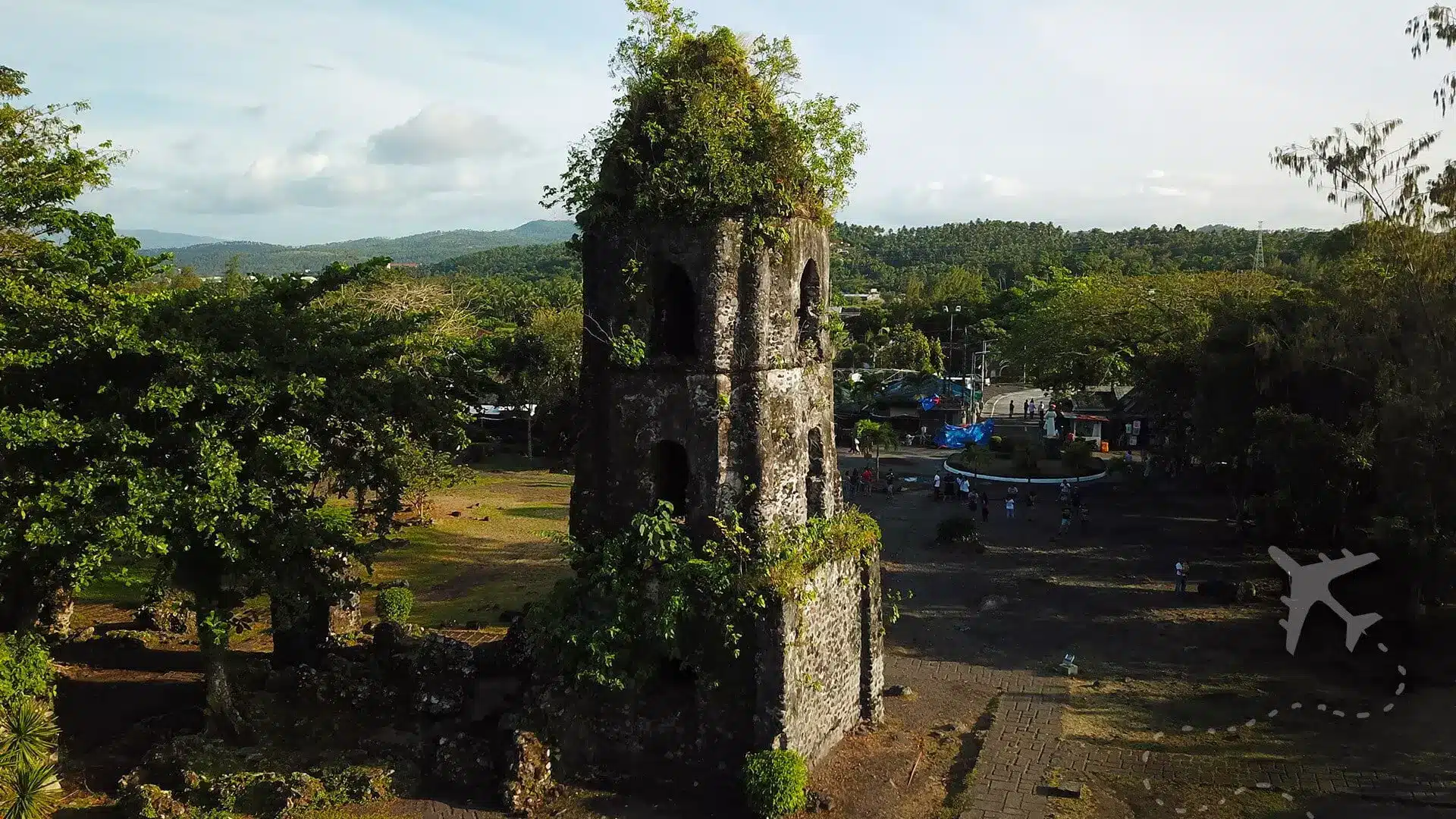
Today, the surviving bell tower has become one of the most recognizable landmarks in Albay.
It’s historic.
It’s beautiful.
It’s absolutely worth visiting.
Just don’t clear your entire afternoon.
Destination: cagsawa ruins
GPS COORDINATES
13.1661, 123.7011
CLOSEST AIRPORT
CURRENT WEATHER
light rain (81F / 27C)

AIR QUALITY INDEX (AQI)
Good (42)
THEY BUILT IT. PIRATES BURNED IT. THEY BUILT IT AGAIN.
Cagsawa had a rough couple of centuries even before becoming a tourist attraction.
A Franciscan mission was established here in the late 1500s, with an early church serving the growing settlement. Then Dutch raiders came through in 1636 and burned it down.
Fine.
Build another one.
A larger stone church and convent were constructed in 1724 under Franciscan friar Francisco Blanco. The complex eventually included the church, convent, bell tower and other buildings serving the community.
For a while, things apparently went pretty well.
Then February 1, 1814 arrived.
And Cagsawa’s real-estate market experienced what could generously be described as a correction.
The town was devastated during the eruption that day. Historical markers at the site record approximately 1,200 deaths, and the surviving residents eventually relocated and incorporated their community into nearby Daraga.
What remained of the church was abandoned.
More than 200 years later, tourists like me now show up with cameras.
History is weird.
GOOD NEWS: YOU’RE PROBABLY NOT GETTING LOST
Cagsawa isn’t some sprawling archaeological site.
There aren’t miles of ruins hidden in the jungle.
You’re not going to need hiking boots, three liters of water and a local guide named Ernesto carrying a machete.
The ruins are right there.
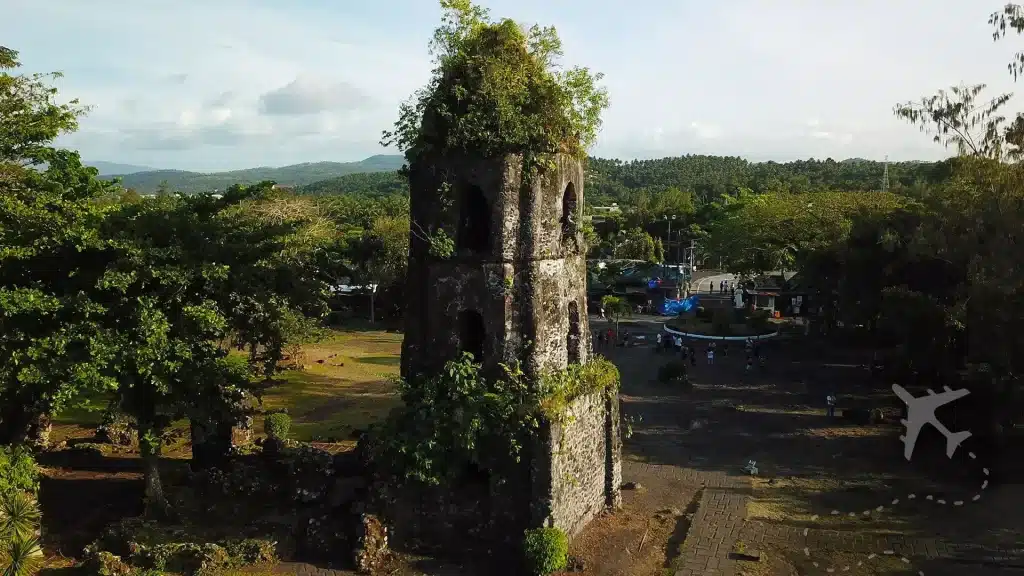
The bell tower gets virtually all the attention, but pieces of the church walls, arches and other structures remain around the grounds. The surviving masonry gives you at least some sense of the footprint of the old complex rather than just presenting a random tower sitting alone in a field. citeturn0search0
So I wandered around.
Looked at the tower.
Looked through the old stone openings.
Took pictures.
Walked to another side.
Took remarkably similar pictures.
Walked farther.
Took more pictures.
At some point, you inevitably realize you’ve now photographed the same bell tower from enough angles to construct a three-dimensional model of it.
Cagsawa complete.
There’s simply not a tremendous amount to explore.
That doesn’t make it disappointing. It just makes it a short destination.
Come for the history.
Take your pictures.
Walk around the ruins.
Appreciate where you’re standing.
Then go do something else.
AND HOLY SHIT, IT’S PHOTOGENIC
For something consisting largely of old rocks, Cagsawa photographs ridiculously well.
The weathered stone, tropical landscape and isolated bell tower already give you plenty to work with.
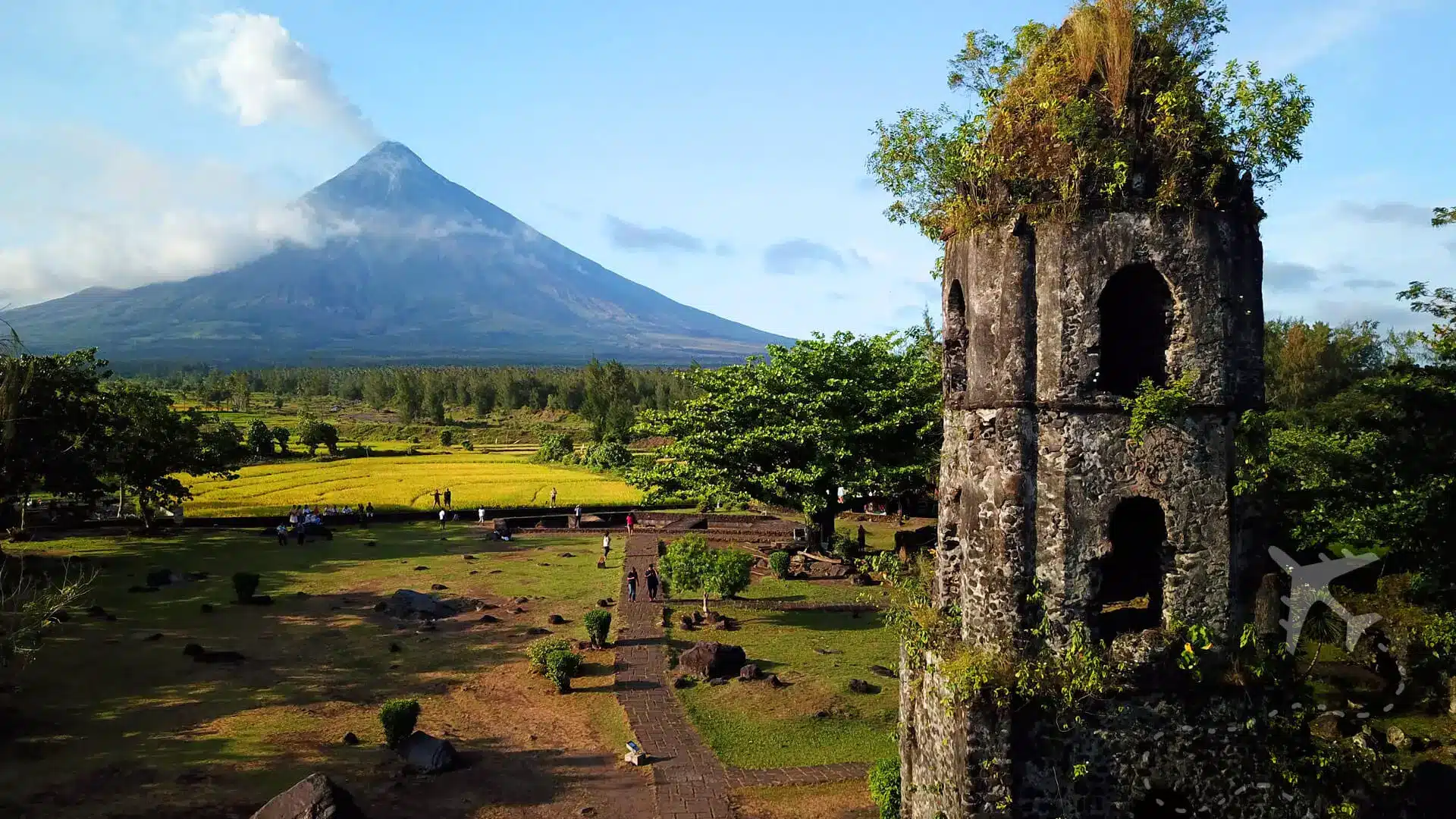
Then there’s that enormous mountain photobombing everything in the background.
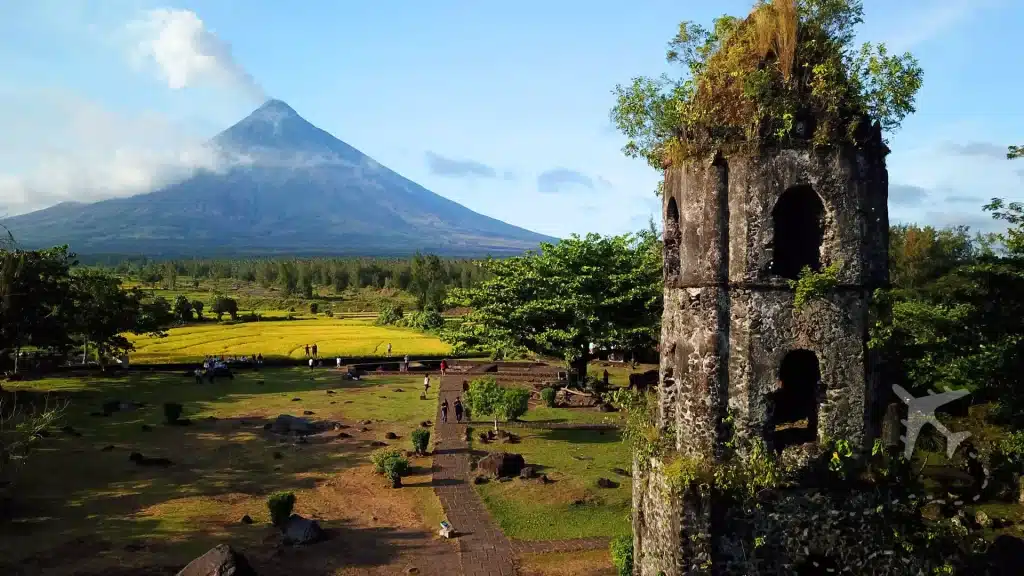
Mayon Volcano is basically Cagsawa’s unpaid photography assistant that lives rent free in all the pictures.
On a clear day, its almost perfectly symmetrical cone rises directly behind the ruins, producing the photograph everyone comes here to get.
And yes, it looks just as impressive in person.
There is also some rather obvious historical irony involved.
The thing that makes Cagsawa so spectacular today is also the reason Cagsawa is ruins.
That’s one hell of a tourism partnership.
THE LOCATION DEPARTMENT HAD ONE JOB
Standing among the ruins, there’s one tiny detail that’s impossible to ignore.
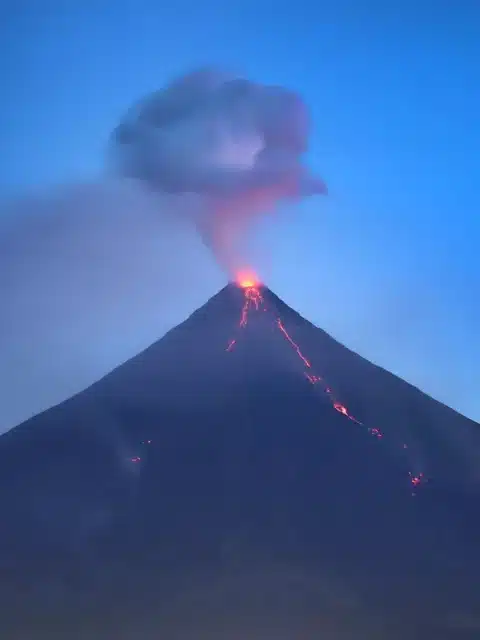
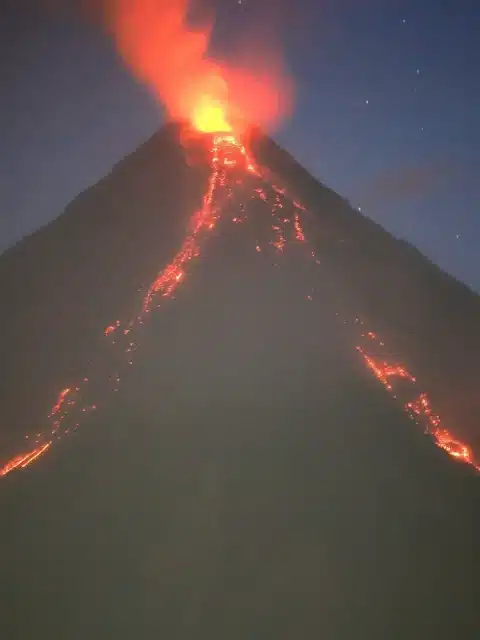
The enormous active volcano directly behind them.
Mayon isn’t some distant mountain requiring binoculars and a helpful local pointing toward the horizon.
It’s just there.
Dominating the landscape.
Looking absolutely gorgeous.
And apparently offering no clues whatsoever that perhaps building substantial communities nearby could occasionally become problematic.
Humanity has always been remarkably talented at looking at obvious natural hazards and deciding: Yeah, but the location is fantastic.
Hurricane zone? Build beachfront condos.
Floodplain? Perfect place for a subdivision.
California hillside that catches fire every six years? Starting in the low $900s.
Giant active volcano? Somebody get the church architect.

Of course, the relationship between the communities of Albay and Mayon is considerably more complicated than simply pointing at a mountain and calling everyone from the 1700s idiots.
And after exploring Mayon Volcano myself, it’s easy to understand why the mountain remains such an enormous part of this region’s identity.
But Cagsawa provides a fairly effective historical reminder that spectacular scenery sometimes comes with terms and conditions.
The bell tower survived.
Most of everything around it didn’t.
And more than two centuries later, Mayon still has the audacity to stand behind the ruins looking absolutely fucking magnificent.
THEN I DISCOVERED INTERNATIONAL PARKING ECONOMICS
My visit was going pretty well.
Interesting history.
Beautiful ruins.
Fantastic pictures.
Easy place to explore.
Then I parked.
And apparently my foreign face triggered the International Premium Parking Experience™.
Because I was charged roughly twice as much to park.
Why?
Foreigner.
Obviously.
Now, the actual amount wasn’t enough to financially destroy me.
I didn’t need to call my bank.
I didn’t have to liquidate my retirement account.
I survived.
But it still pissed me off.
Because my car didn’t suddenly become twice as large when they realized I wasn’t Filipino.
It didn’t occupy two parking spaces.
It didn’t require imported asphalt.
Nobody detailed it while I was wandering around the ruins.
It sat there.
Motionless.
On the same ground as every other vehicle.
Apparently mine was simply enjoying the Premium Caucasian Pavement Package.
If you’re going to charge me twice as much, at least make an effort.
Give me valet parking.
Wash the car.
Put a velvet rope around it.
Hand me a cold beverage.
Have somebody stand beside the vehicle wearing white gloves and announce: “Sir, your internationally priced automobile has been secured.”
Something.
Instead, I paid double for the exciting privilege of leaving my vehicle completely unattended while I spent less than an hour looking at a bell tower.
Excellent.
THE HISTORY IS WHAT MAKES IT WORTH VISITING
Take away the story and Cagsawa is basically a collection of old stone walls.
The history changes everything.
This wasn’t some church gradually abandoned when everyone moved somewhere else.
An entire community existed here.
People lived here.
Families worshipped here.
The buildings surrounding the church were part of a functioning town.
Then one morning in 1814, that world effectively disappeared.

The surviving residents eventually relocated to Daraga, while the ruined church remained behind as a physical marker of what happened.
That context makes walking around Cagsawa considerably more interesting than the size of the attraction would suggest.
It’s something I’ve encountered repeatedly while visiting dark tourism destinations.
Sometimes there isn’t much physically left.
The story is the attraction.
At Duga Radar near Chornobyl, the massive Soviet structure tells a story considerably bigger than the abandoned metal itself.
At Cagsawa, it’s an old bell tower.
You can walk around it in minutes.
But once you understand why it’s still standing there alone, it becomes much more interesting.
THIS IS NOT AN ALL-DAY RELATIONSHIP
Cagsawa is one of those destinations where travel writers occasionally struggle with an uncomfortable truth: There just isn’t that much to do.
So they’ll start padding.
Explore the grounds. I did.
Admire the architecture. Done.
Experience the atmosphere. Experienced.
Reflect upon centuries of history. Reflected.
Now what?
You can spend longer here if you’re really interested in the architecture, want to take your time with photography or simply enjoy hanging around historic places.
But you absolutely don’t need to manufacture a three-hour Cagsawa itinerary.
The place doesn’t need it.
Cagsawa is a quick hit of Philippine history with an incredible backdrop.
That’s enough.
It actually reminds me of Fort San Pedro in Cebu.
Historically important? Yep.
Worth seeing? Absolutely.
Should you cancel dinner because you’re still exploring six hours later? Jesus Christ, no.
Visit.
Learn something.
Take pictures.
Move along.
Travel doesn’t need to become an endurance competition where the quality of an attraction is determined by how many hours it prevents you from leaving.
SHOULD YOU VISIT CAGSAWA RUINS?
Absolutely.
Just calibrate your expectations.
You’re not coming here because there are endless things to see.
You’re coming because Cagsawa is a fascinating little piece of Philippine history that happens to be ridiculously photogenic.
The ruins are beautiful.
The story behind them is tragic.
The bell tower is iconic.
And the whole thing is compact enough that you can experience it without sacrificing half your day.
Walk around.
Take the obligatory tower photos.
Read about the people who once lived here.
Admire the spectacularly questionable historical site selection.
Then continue exploring Albay.
Cagsawa doesn’t need three hours of your time to justify the visit.
An hour, some good photographs and a little historical perspective will do just fine.
Just remember to bring a few extra pesos.
Apparently foreign cars consume twice as much parking lot.