


There are certain combinations of words that sound virtually impossible to fuck up.
Baby elephant orphanage is pretty high on that list.
Baby elephants?
Excellent.
A whole bunch of baby elephants?
Even better.
A place in Kenya dedicated to taking care of them?
Shut up and take my money.
That was roughly the level of intellectual preparation I brought to the David Sheldrick Elephant Orphanage when I visited Nairobi in July 2017.
I figured this would be adorable.
I was correct.
What I wasn’t prepared for was everything else.
Because after about thirty seconds of watching tiny elephants enthusiastically demolish enormous bottles of milk, something fairly important works its way through your skull:
Every one of these elephants is here because something went horribly wrong.
Suddenly one of the cutest fucking places in Kenya becomes one of the most emotionally complicated places I’ve ever visited.
DESTINATION: KENYA BABY ELEPHANT ORPHANAGE
GPS COORDINATES
-1.3768, 36.7741
CLOSEST AIRPORT
CURRENT WEATHER
scattered clouds (84F / 29C)

AIR QUALITY INDEX (AQI)
Good (3)
THE KENYA BABY ELEPHANT ORPHANAGE I THOUGHT WOULD JUST BE CUTE
The Sheldrick Wildlife Trust’s Nairobi Nursery sits on the edge of Nairobi National Park, which already offers one of the strangest wildlife experiences I’ve had in Africa.
You can be surrounded by legitimate African wilderness while Nairobi’s skyline casually exists in the background.
Lions.
Rhinos.
Giraffes.
Zebras.
Probably somebody sitting in traffic a few miles away questioning every decision that led them there.
Then, tucked into all of this, is a place caring for baby elephants that have lost their mothers and can’t survive on their own.
I knew that before arriving.
I understood the definition of orphanage.
My brain had processed the necessary vocabulary.
Apparently my emotions had not received the memo.
Because there’s a considerable difference between reading the words orphaned baby elephants and standing there as a herd of them comes charging out of the forest.
OH MY GOD. ELEPHANTS.
When I visited in July 2017, the public experience centered around one of the most important events in any baby’s life: Lunch.
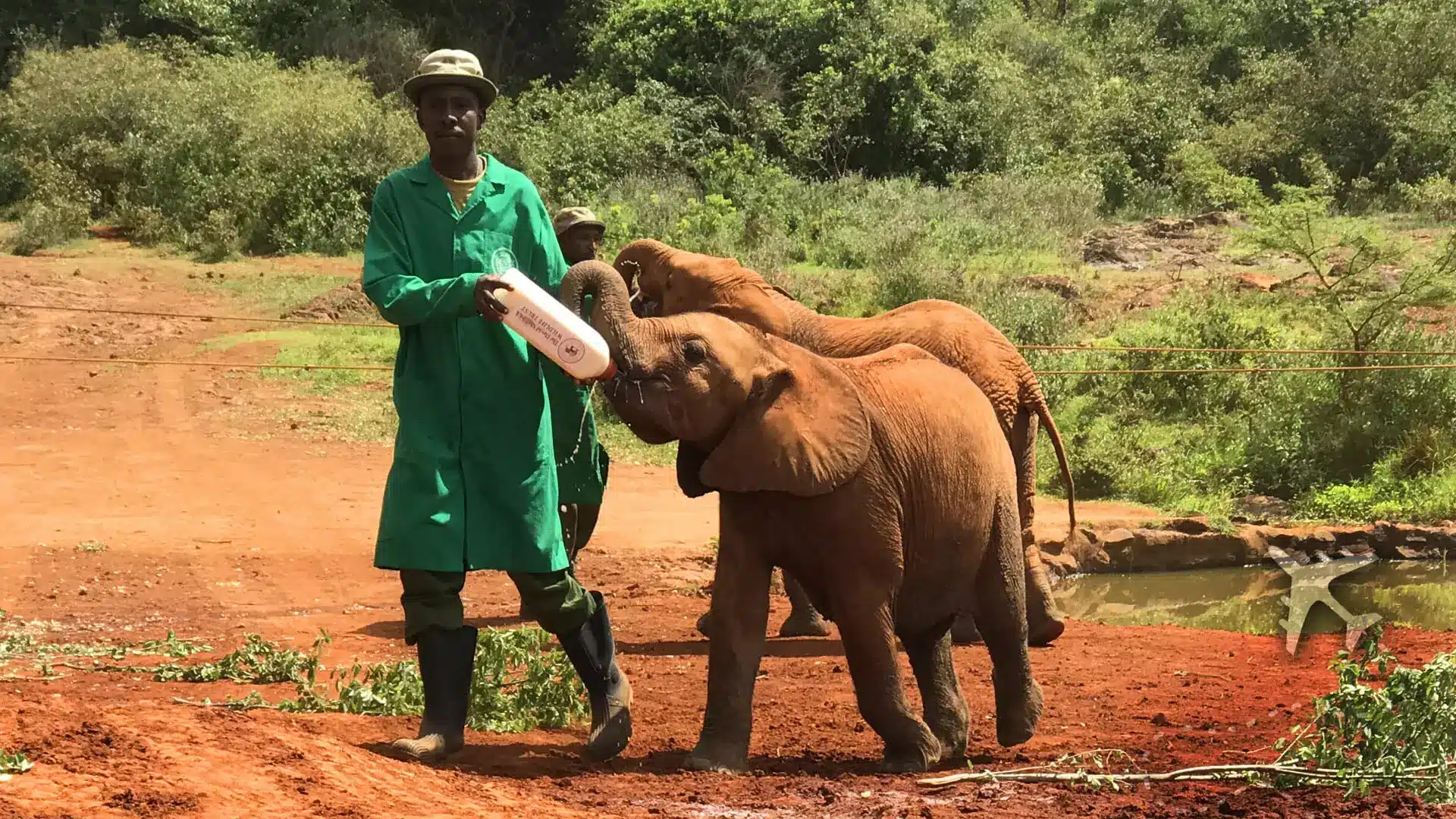
At 11:00 AM, the elephants came enthusiastically marching out for bottles of specially formulated milk.
And when I say bottles, I’m not talking about something you’d casually toss into a diaper bag.
These were elephant bottles.
Basically agricultural equipment with nipples.
The keepers grabbed them.
The elephants grabbed them.
And approximately four seconds later the milk was gone.
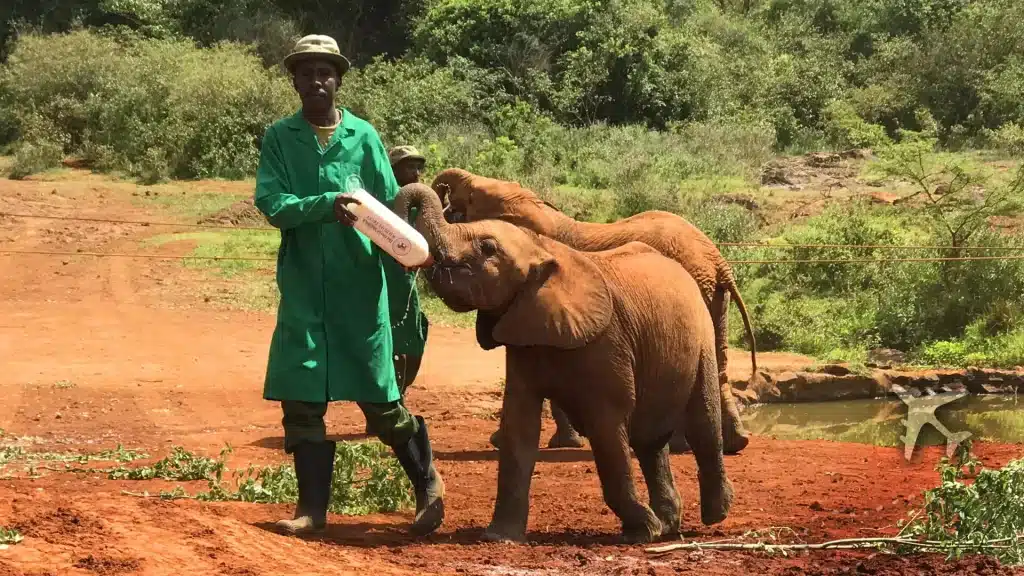
Apparently growing into a six-ton land mammal requires calories.
Who knew?
Then came playtime.
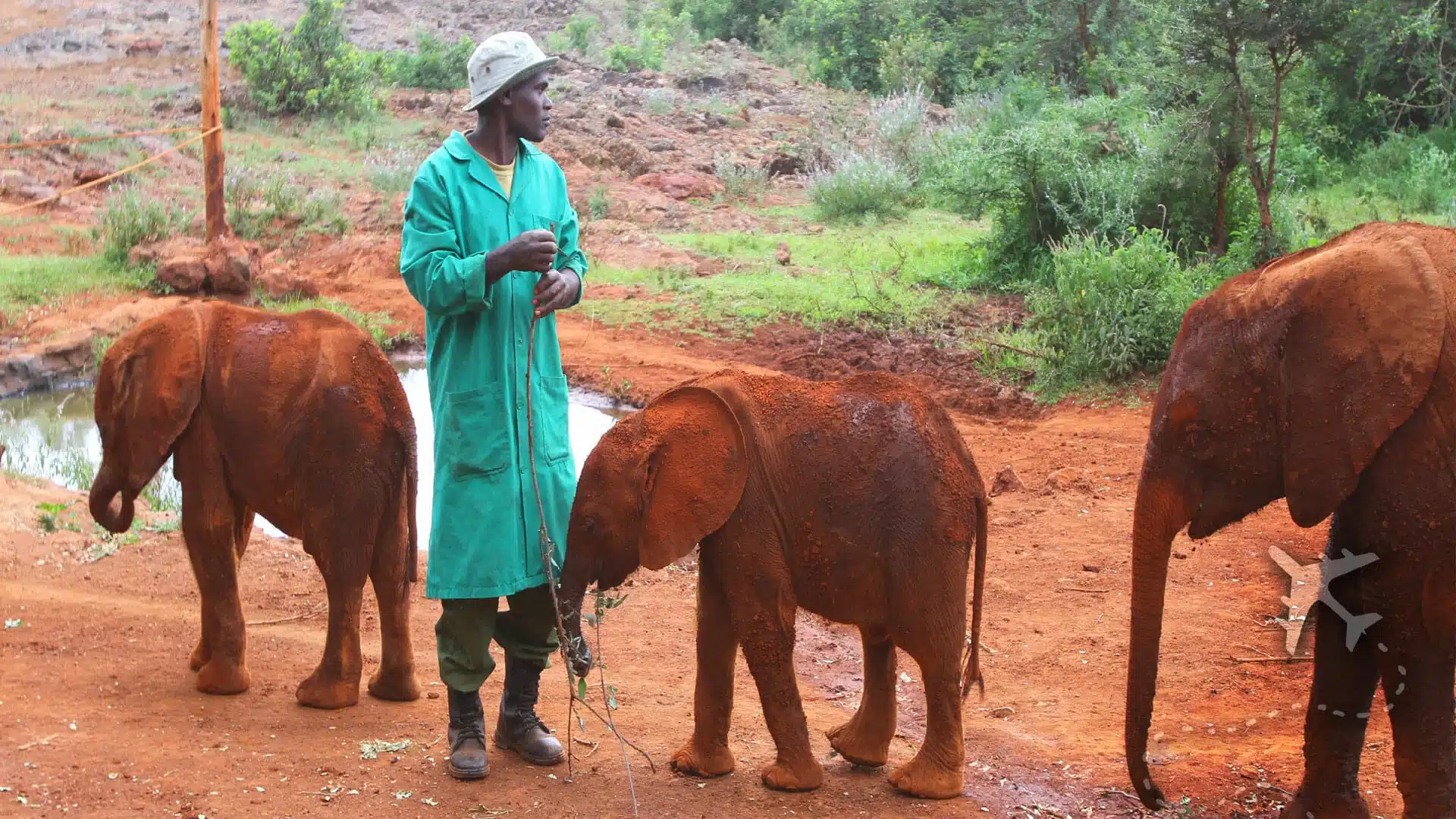
Mud.
Dirt.
Water.
Wrestling.
More mud.
An elephant rolling around like a drunk toddler who discovered a puddle.
Another throwing dirt everywhere.
Another wandering suspiciously close to the humans attempting to photograph all of this.
For a while, visiting the baby elephant orphanage in Kenya was exactly what I’d expected.
Absolutely fucking adorable.
People smiling.
Cameras firing.
Elephants doing elephant shit.
And then you start thinking about why they’re here.
I’M NOT CRYING, YOU’RE CRYING.
These weren’t elephants being raised for entertainment.
They were there because they couldn’t survive by themselves.
Their mothers were gone.
Some had been orphaned because of poaching. Others because of human-wildlife conflict, habitat pressures and other circumstances that left a baby elephant alone in a world where being alone can basically become a death sentence.
That’s when the experience punched me directly in the emotional testicles.
Because elephants are intensely social animals.
A baby elephant isn’t supposed to figure this shit out alone.
It’s supposed to have a mother.
A family.
A herd.
Instead, you’re standing there watching one enthusiastically drink milk from a giant bottle because a human being has temporarily taken over a job that should have belonged to its mother.
It was fucking crushing.
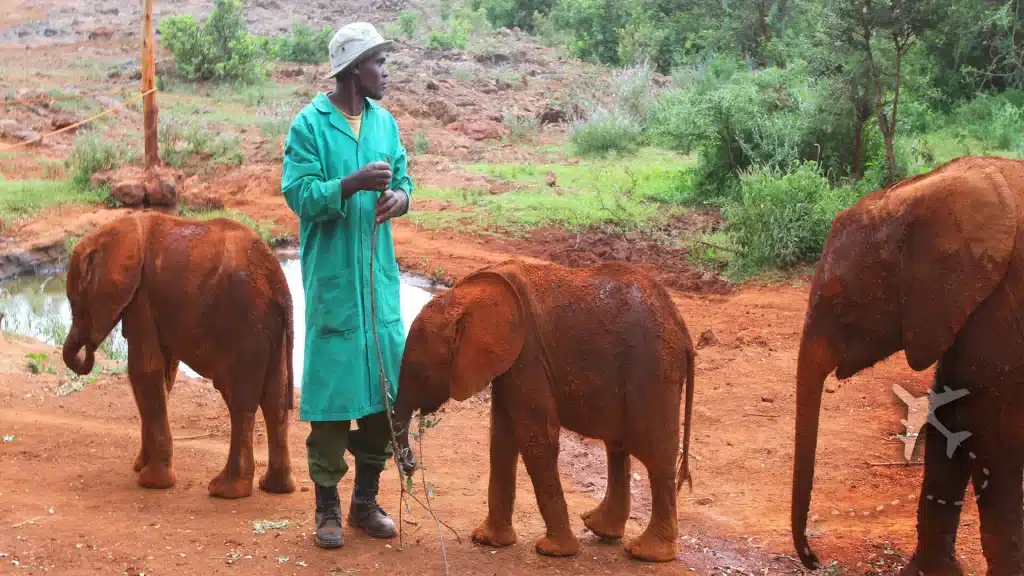
But then I started paying more attention to the people holding the bottles.
HUMANS FUCKED THIS UP. OTHER HUMANS ARE TRYING TO FIX IT.
There is something painfully human about the entire operation.
Our species is exceptionally good at creating problems and then requiring another group of considerably better humans to dedicate their lives to fixing them.
And that’s exactly what was happening in front of me.

The keepers weren’t just showing up at 11:00 AM to hand out bottles while tourists took pictures.
Raising an orphaned elephant requires an absurd level of commitment.
Feeding.
Protection.
Companionship.
Medical care.
Constant attention.
Basically all of the responsibilities associated with raising a child, except your child will eventually weigh several tons and can push over a tree.
The more I watched the keepers interact with the elephants, the more the entire experience changed.
Because the goal of the Sheldrick Wildlife Trust isn’t to collect elephants.
The goal is to get rid of them.
Eventually.
In the best possible way.
SUCCESS MEANS THE ELEPHANTS LEAVE
This is the part that separates the Sheldrick Wildlife Trust from the depressing collection of wildlife attractions around the world where animals conveniently remain available for tourist entertainment forever.
These elephants aren’t supposed to stay here.
The Nairobi Nursery is the beginning of a much longer rehabilitation process.
Rescue them.
Stabilize them.
Raise them.
Teach them how to elephant.

Then, when they’re ready, begin the long process of reintegrating them into the wild.
That means success isn’t measured by how many elephants they have.
Success is an elephant they don’t have anymore.
An elephant that grows up.
Joins other elephants.
Builds relationships.
Walks away.
Becomes wild.
And ideally spends the rest of its life having absolutely nothing to do with us.
That’s a pretty fucking beautiful definition of success.
THE ROPE WAS DEFINITELY FOR US
During my July 2017 visit, everyone gathered around the perimeter while the elephants ate, played and generally demonstrated why wearing clean clothing to an elephant orphanage is questionable decision-making.
There was a rope separating us from them.
Let’s establish something important about this rope.
It was not stopping the elephants.
An elephant does not look at a waist-high piece of rope and think: Well, shit. Impenetrable human engineering. Guess I’ll turn around.
The rope was for us.
Because humans require boundaries.
Especially humans holding cameras.
Without that rope, somebody would inevitably have attempted to climb onto an elephant for Instagram while another person complained that the elephant wasn’t facing the correct direction for their selfie.
The elephants wandered around.
We stayed where we belonged.
Mostly.
Back then, the experience allowed considerably closer interaction than it does today. Elephants would wander close enough that you could really appreciate just how wonderfully bizarre these animals are.
The enormous ears.
The wrinkled skin.
The little hairs.

And the trunk, which is essentially what happens when evolution attaches a shop vacuum hose to the front of an animal.
I’d seen elephants elsewhere in Africa, including while searching for the Big Five in Pilanesberg National Park.
But this felt completely different.
On safari, seeing an elephant feels triumphant.
You found one.
It’s wild.
It’s enormous.
It’s wandering around Africa exactly where an elephant belongs.
Here, seeing one felt wonderful and terrible simultaneously.
Because you’re incredibly happy it’s alive.
And painfully aware of why you’re able to stand this close to it.
ELEPHANTS LOVE MUD. YOUR CLOTHES WILL LEARN THIS.
Once the milk disappeared, things got considerably messier.
Baby elephants apparently operate under the same general philosophy as human toddlers: If something can make you filthy, investigate immediately.
They rolled in dirt.
Splashed in water.
Threw mud.
Sprayed things.
Rolled around some more.
Then occasionally wandered toward the visitors looking extremely pleased with whatever destruction they’d just accomplished.
If you arrived clean, that was really more of a temporary condition.
And I loved every second of it.

This was the emotional whiplash of visiting the Kenya baby elephant orphanage.
One minute you’re laughing because a baby elephant has turned itself into a mud-covered wrecking ball.
The next you’re remembering why that elephant needs somebody to prepare a bottle for it.
Happy.
Sad.
Happy again.
Then fucking sad again.
It was exhausting.
THIS ISN’T REALLY AN ELEPHANT SANCTUARY
A lot of people searching for this place call it an elephant sanctuary in Kenya, which makes sense.
Elephants.
Protected place.
Humans helping them.
Sanctuary.
Close enough.
But that description misses what made the place so memorable for me.
This isn’t supposed to be their forever home.
It’s more like elephant rehab.
Rescue them.
Keep them alive.
Give them the support they lost.
Then spend years slowly preparing them for the day they don’t need you anymore.
The Sheldrick Wildlife Trust says more than 300 orphaned elephants have been raised through its Nairobi Nursery since it was established in 1987.
That’s an incredible accomplishment.
It’s also a fucking depressing number.
Because you want that number to be zero.
But since it isn’t, I’m incredibly grateful somebody is standing there holding the bottles.
IN 2017, SEVEN BUCKS AND A LITTLE PATIENCE GOT YOU IN
When I visited in July 2017, seeing the elephants was considerably more casual than it is today.
Admission was around US$7.
There wasn’t an elaborate booking process.
The primary strategy was essentially: Show up early and be better at standing in line than everyone else.
Even then, this wasn’t some undiscovered little wildlife secret.
Hundreds of people wanted in.
Visitors would start gathering 30–60 minutes before the 11:00 AM feeding because everyone wanted a place close enough to actually see the elephants instead of returning home with 200 photographs of the back of another tourist’s head.
Capacity was limited.
If you didn’t make it in?
Congratulations.
Nairobi has plenty of other things to do.
Try again tomorrow.
It was popular in 2017.
Apparently the secret got out.
NOW EVERYONE WANTS TO SEE THE BABY ELEPHANTS
Today, visiting the Sheldrick Wildlife Trust’s elephant orphanage in Nairobi requires considerably more planning.
You need to book in advance.
The public visit still takes place from 11:00 AM until noon, but visitors now make a minimum US$20 adult donation to the Sheldrick Wildlife Trust, plus the separate entrance fee required for Nairobi National Park.
And the casual interaction I experienced back in 2017 has changed too.
Visitors don’t feed or directly interact with the elephants today.
Their keepers handle that.
Which might sound disappointing until you remember something fairly important: These elephants aren’t here for us.
They’re not domesticated animals being trained to entertain tourists.
They’re being prepared for a life where hopefully they’ll never need another fucking human again.
So yes, it costs more than the seven bucks I paid in 2017.
Yes, reservations are required.
Yes, the experience is more controlled.
And in this particular case, I’m completely fine with all three.
THIS MIGHT BE THE ONE TIME I’M HAPPY A PLACE GOT MORE POPULAR
I’ve watched tourism completely overwhelm some incredible places.
Beautiful destinations become Instagram assembly lines.
Quiet places become crowded.
Interesting experiences become conveyor belts.
Usually when I hear somewhere has become dramatically more popular since I visited, my immediate reaction is:
Well, there goes the fucking neighborhood.
Not here.
Because people didn’t discover the Sheldrick Wildlife Trust because somebody installed an Instagram swing overlooking Nairobi.
They discovered the elephants.
They discovered their stories.
They discovered the keepers.
They discovered an organization trying to return orphaned elephants to the wild.
And apparently a whole lot of people responded: Take my money. I would like to help the baby elephants.
Good.
More visitors mean more awareness.
More awareness means more support.
And more support means the people trying to fix what humans keep fucking up have a little more help doing it.
If becoming popular helps keep the bottles full and gives more orphaned elephants a chance to eventually disappear into the African wilderness, then congratulations.
Become fucking famous.
I CAME FOR BABY ELEPHANTS. I LEFT THINKING ABOUT HUMANS.
That’s what stayed with me.
Not the photographs.
Not the giant milk bottles.
Not even the tiny elephants launching mud toward tourists with what I can only assume was deliberate targeting.
It was the contradiction.
I left heartbroken that the David Sheldrick Elephant Orphanage needs to exist.
And incredibly grateful that it does.
There are people who have dedicated their lives to rescuing animals most of us will see for an hour, photograph enthusiastically and then fly halfway around the world away from.
When the tourists leave at noon, the work doesn’t stop.
The elephants still need feeding.
Still need care.
Still need protection.
Still need somebody willing to take responsibility for keeping them alive long enough that hopefully, someday, they won’t need humans anymore.
I expected visiting a baby elephant orphanage in Kenya to be one of the cutest wildlife experiences of my life.
It absolutely was.
But watching a tiny elephant happily inhale a bottle of milk becomes considerably more complicated when you realize its mother should have been standing there instead.
That’s the emotional sucker punch.
The elephants are adorable.
Their stories aren’t.
And standing between those two realities are some pretty incredible people trying to undo a tiny piece of the damage our species keeps leaving behind.
Sometimes humans are the fucking worst.
Thankfully, sometimes they’re pretty fucking incredible too.
