

A long’ish weekend in Costa Rica left me with a rental car, absolutely no responsible itinerary and the dangerous realization that there were a bunch of interesting things within driving distance of San José.
So naturally: Volcano? Sure.
I punched Irazu Volcano into the GPS and started driving into the mountains.
Because apparently when presented with several perfectly reasonable ways to spend a weekend in Costa Rica, I will consistently choose “drive toward active geological features.”
This personality defect has since taken me to Kawah Ijen where sulfur clouds try to murder you before breakfast, Gunnuhver where Iceland appears to be pressure-cooking itself, and enough other volcanoes that DESTINATIONS UNKNOWN now has an entire section appropriately dedicated to Fire, Lava & Bad Ideas.
Irazu seemed considerably more civilized.
Drive up.
Walk around.
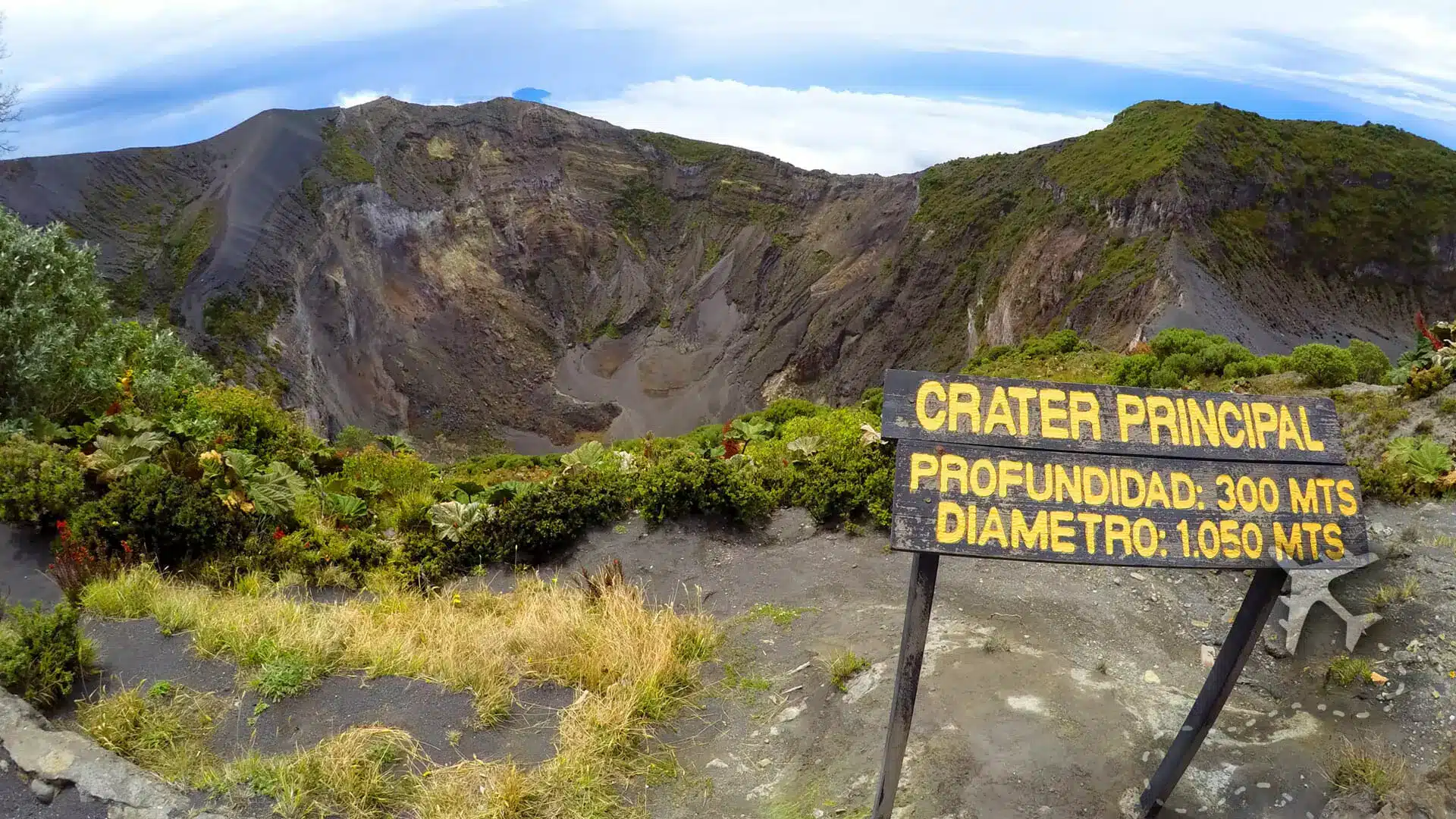
Look into enormous volcanic crater.
Take pictures.
Try not to trigger eruption.
Perfect weekend activity.
DESTINATION: Irazu Volcano
GPS COORDINATES
9.9800, -83.8491
CLOSEST AIRPORT
CURRENT WEATHER
overcast clouds (43F / 6C)

AIR QUALITY INDEX (AQI)
Moderate (61)
IRAZU VOLCANO: BECAUSE NORMAL WEEKENDS ARE BORING
Irazu Volcano sits in Costa Rica’s Cartago Province, roughly 50 kilometers from San José, which makes it an extremely tempting day trip if you’re already wandering around the capital wondering what the hell to do with yourself.
More importantly, Irazu is the highest active volcano in Costa Rica, rising 3,432 meters, or 11,260 feet, above sea level.

And that elevation becomes increasingly obvious as you drive there.
The road out of San José starts climbing into the mountains through increasingly beautiful scenery, with plenty of winding roads, farms and little communities along the way.
At some point during the drive, I noticed something else.
It was getting colder.
Ah yes.
Altitude.
We meet again.
APPARENTLY MOUNTAINS ARE COLD
I have a remarkable ability to travel somewhere tropical and forget that mountains continue obeying the laws of atmospheric science.
Costa Rica was warm.
Therefore Costa Rica would remain warm.
Science.
Except Irazu’s summit is sitting more than three kilometers above sea level, and apparently the atmosphere didn’t consult my wardrobe before adjusting the temperature accordingly.
By the time I reached Irazu Volcano National Park, the difference from San José was extremely noticeable.
Not Dieng Plateau cold.
Dieng was an entirely different category of bullshit.
I arrived there during an Indonesian road trip with a suitcase full of shorts and T-shirts only to discover that Indonesia apparently contains a secret walk-in freezer in the mountains. Irazu wasn’t remotely that brutal.

But it was definitely “maybe shorts weren’t the optimal strategic decision” cool.
This is one of those things that’s incredibly easy to underestimate when visiting Irazu Volcano from San José. You’re gaining thousands of meters of elevation surprisingly quickly, and temperatures at the summit can be dramatically cooler than what you left behind.
Bring a jacket.
Or don’t.
Shivering builds character.
WELCOME TO COSTA RICA’S HIGHEST ACTIVE VOLCANO
Once I arrived, Irazu immediately started showing off.
The volcano is the centerpiece of Irazu Volcano National Park, and despite being converted into an extremely accessible tourist attraction complete with parking, trails, viewpoints and railings designed to prevent humanity from testing gravity, Irazu is still very much an active volcano.
It has produced numerous documented eruptions over the centuries, including significant activity during the 1960s and another eruption in 1994.
So yes.
You’re walking around an active volcano.

It’s just currently behaving itself.
Which is an important distinction.
I’ve been around volcanoes that were considerably less committed to good behavior. Lewotobi Laki-Laki in Indonesia demonstrated rather effectively what happens when a volcano stops being an interesting geological attraction and starts rearranging the surrounding countryside.
Irazu, thankfully, was having a quiet day.
THE CLOUDS ARE…
Wait.
Why are the clouds down there?
This was the moment Irazu went from cool volcano to holy shit.
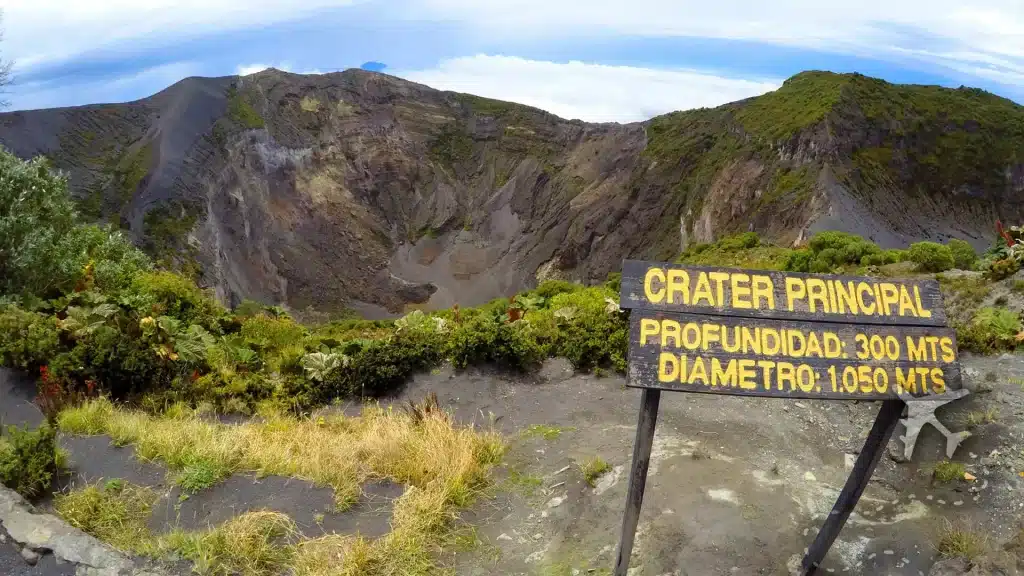
The hiking trails and viewpoints around the summit give you different perspectives across the enormous volcanic landscape, and as the cloud cover shifted, I suddenly realized I wasn’t looking at the clouds.
I was looking down at them.

That fucks with your brain a little bit.
We’re accustomed to clouds being above us.
That’s where clouds live.
Clouds have an assigned seating area.
Sky.
Except at more than 11,000 feet above sea level, Irazu puts you high enough that the clouds can be rolling across the landscape thousands of feet below your position.
Suddenly you’re standing beside an enormous volcanic crater looking across this strange barren landscape while a blanket of white clouds sits beneath the mountain.
And yeah.
That’s pretty fucking awesome.
IRAZU’S WEATHER HAS ITS OWN PLANS
Of course, getting these views isn’t guaranteed.
High mountains enjoy reminding photographers who’s actually in charge.
When I was driving toward Irazu, thick clouds and fog were covering portions of the mountain, which had me increasingly convinced I’d driven two hours to photograph approximately seven feet of gray nothingness.
Excellent.
Another successful photography expedition.
Then, not long after I reached the summit, everything started changing.
The clouds moved.
Blue sky appeared.
Sunlight started hitting the crater.
And Irazu basically went from Windows default gray background to one of the coolest landscapes I’d seen in Costa Rica.

This is why weather matters tremendously when visiting Irazu Volcano.
Clouds and fog can completely swallow the summit, but conditions can also change ridiculously fast.
If visibility sucks when you arrive, don’t immediately assume you’ve lost.
Walk around.
Give Mother Nature a few minutes to finish being dramatic.
WALKING AROUND IRAZU VOLCANO
One thing I loved about Irazu was how easy it was to explore.
You don’t need to undertake some heroic expedition involving ropes, oxygen tanks and a Sherpa named Tenzing.
There are walking areas and trails around the volcanic landscape that let you explore different perspectives of the crater and surrounding mountains.
And the scenery changes constantly.
One direction gives you the crater.
Another gives you rugged volcanic terrain.
Turn around again and suddenly you’re staring across Costa Rica with clouds floating below you.
It’s the kind of place where I kept walking another hundred feet because there was clearly another photograph over there.
Then another.
Then another.
And suddenly my casual volcano visit had turned into several hundred photographs of rocks, clouds and a giant hole in the Earth.
My camera has suffered greatly because of my inability to recognize when I already have enough pictures.
YES, IRAZU IS STILL AN ACTIVE VOLCANO
One of the strangest parts about Irazu is how easy it becomes to forget what you’re actually standing on.
Parking lot.
Walking paths.
Railings.
Signs.
Tourists.
Cameras.
Everything feels very controlled.
Then you look across the crater and remember:
Oh yeah. Giant active volcano.
Irazu has erupted repeatedly throughout recorded history, with its most famous modern eruptive period beginning in 1963.
That history is part of what makes walking around the summit so interesting.
The crater isn’t some ancient geological relic that finished doing interesting shit millions of years ago.
You’re looking at a volcanic system that is currently quiet.
Not extinct.
Quiet.
There’s a difference.
And after visiting places like Rano Kau on Easter Island, where an enormous extinct volcanic crater has essentially been reclaimed by vegetation, Irazu feels considerably more raw.
Less nature has moved in.
More nature has temporarily stepped away from the controls.
THE VIEW IS BIGGER THAN THE VOLCANO
I came to Irazu because volcanoes are cool.
Very sophisticated travel planning.
But strangely, the crater wasn’t what stuck with me most.
It was the elevation.
Standing there looking down at clouds completely changed the scale of everything around me.
The roads I’d driven.
The mountains.
The valleys.
The towns somewhere below.
All of it suddenly looked very, very small.
Volcanoes have a fantastic way of reminding humans that we’re basically temporary decorations on a planet that has been exploding, collapsing, freezing, flooding and rearranging itself for billions of years.
We build cities.
We invent smartphones.
We argue with strangers on the internet.
Meanwhile Earth casually builds an 11,260-foot volcano.
Perspective.
IRAZU VOLCANO UNCENSORED
Irazu was supposed to be another stop during a long weekend of driving around Costa Rica looking for interesting shit.
Instead, it became one of those places that quietly exceeded expectations.
There’s no insane expedition required.
No 3AM wake-up.
No brutal climb like Mount Bromo.
No toxic sulfur cloud like Kawah Ijen.
No geological feature actively trying to steam your face off like Gunnuhver.
You basically drive from San José into the mountains, watch the temperature steadily fall, arrive at Costa Rica’s highest active volcano and start walking.
Then, if the weather cooperates, you get to stand beside a massive volcanic crater looking down at the fucking clouds.
For something I added to the itinerary with approximately the level of planning involved in ordering lunch, Irazu turned out to be pretty spectacular.
Just bring a jacket.
Because apparently altitude is real.
And apparently I need to keep relearning this.