
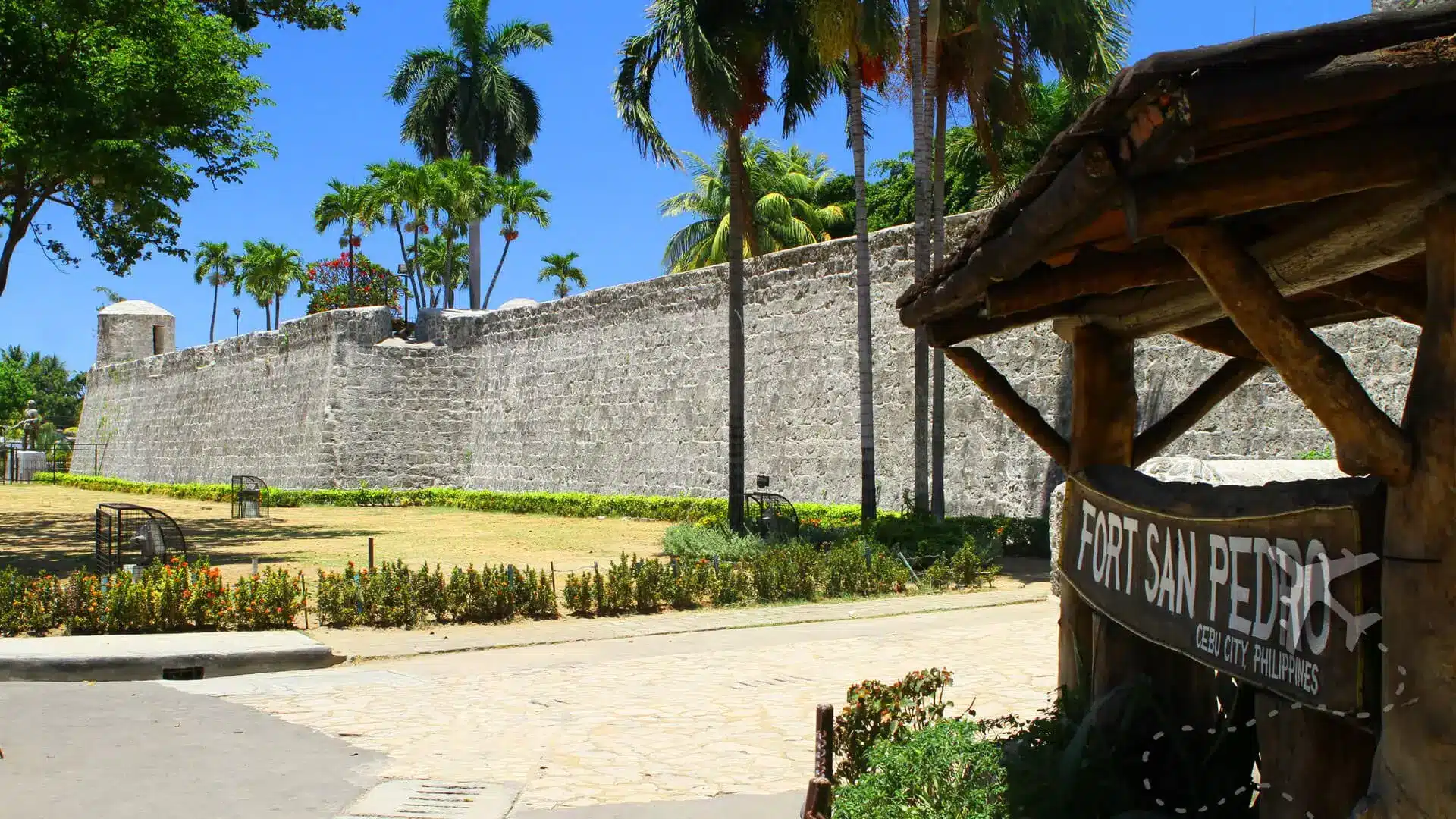


Before you put Fort San Pedro on your Cebu itinerary, let’s manage expectations.
If you’re looking for a sprawling fortress where you can spend half a day getting lost in tunnels, climbing battlements, and uncovering forgotten history, this isn’t it.
If you’re looking for a place that played a pivotal role in shaping the Philippines while only requiring about an hour of your time, then Fort San Pedro is absolutely worth the stop.
It’s one of those destinations that punches well above its weight historically, even if it doesn’t exactly knock your socks off as a tourist attraction.
DESTINATION: Fort San Pedro
GPS COORDINATES
10.2922, 123.9058
CLOSEST AIRPORT
CURRENT WEATHER
clear sky (90F / 32C)

AIR QUALITY INDEX (AQI)
Moderate (56)
Where it all started
Back in 1565, Miguel López de Legazpi landed in Cebu and decided this was a good place to establish Spain’s first permanent settlement in the Philippines.
Naturally, the first order of business wasn’t building churches or markets.
It was building something with cannons.
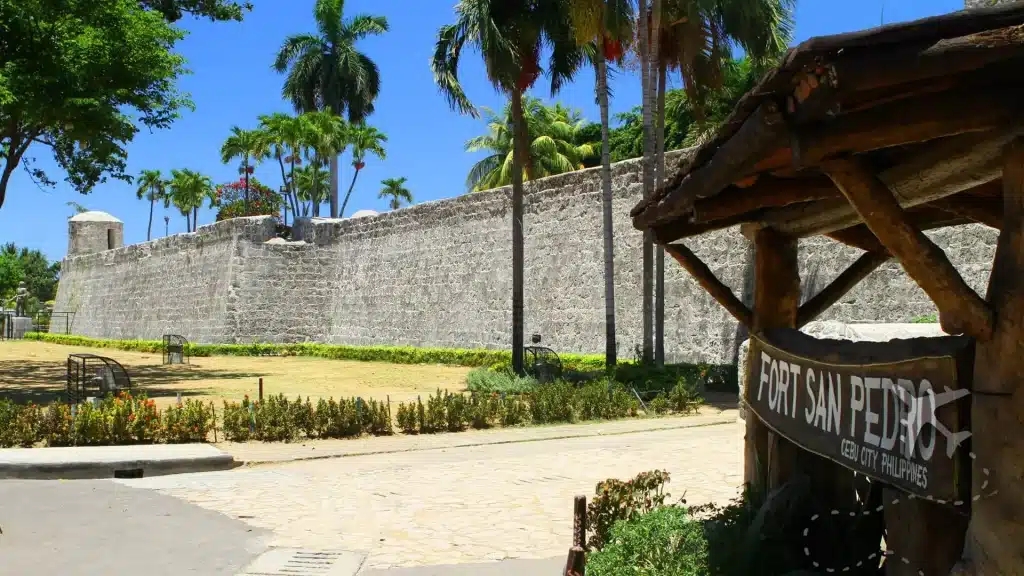
The original Fort San Pedro began as a wooden defensive structure before eventually being rebuilt in coral stone, creating the fortress that still stands today. Over the centuries it served as military headquarters, prison, revolutionary stronghold, American barracks, Japanese camp during World War II, and eventually the historical landmark you see today.
For such a compact little fort, it’s had an incredibly busy résumé.
Small Fort. Big History.
One thing that surprised me was just how…small it actually is.
Photos somehow make it look far larger than reality.
Within minutes you’ve walked the perimeter walls. Another few minutes and you’ve explored the courtyard. Add a museum, a handful of exhibits, some cannons pointed dramatically toward the harbor, and you’ve pretty much seen everything.
I wasn’t disappointed.
I was just finished.
Realistically, unless you’re reading every information board word-for-word, you can comfortably explore the entire complex in about an hour.

Maybe ninety minutes if you’re really taking your time.
That’s not necessarily a criticism.
Not every destination needs to consume an entire afternoon.
Skip The Self-Guided Tour
Technically, you can wander around on your own.
Personally, I wouldn’t.
For a small additional fee, you can hire one of the local guides stationed at the entrance. What makes this genuinely worthwhile is that many of them are local college students completing practical experience as part of their academic requirements.
Instead of someone mechanically reciting dates they memorized fifteen years ago, I ended up with an enthusiastic guide who actually enjoyed talking about Cebu’s history.
The tour felt conversational rather than scripted.
They pointed out details I would’ve walked straight past, explained why the fort’s unusual triangular design mattered, and added local stories that you’ll never find on the information plaques.
For the price of a coffee, it’s an easy upgrade.
What You’ll Actually See
Inside the fort you’ll find restored walls, old cannons, small museum exhibits, historical photographs, Spanish-era artifacts, and enough information panels to satisfy the history buffs.
The coral stone walls themselves are probably the most interesting part.

Considering they’ve survived nearly five centuries of tropical weather, earthquakes, wars, and humanity generally doing what humanity does, they’re holding up remarkably well.
The gardens inside are nicely maintained and provide a surprisingly peaceful escape from Cebu City’s nonstop traffic just outside the gates.
Don’t expect hidden tunnels.
Don’t expect massive underground chambers.
Don’t expect some cinematic medieval fortress experience.
This place is about understanding history rather than chasing adrenaline.
Is Fort San Pedro Worth Visiting?
Absolutely.
Would I make it the centerpiece of a Cebu itinerary?
Probably not.
Fort San Pedro is one of those attractions that’s worth seeing because of what it represents rather than what you’ll actually do there.
It’s a place where the historical significance vastly outweighs the entertainment value.
Spend an hour.
Hire the student guide.
Learn something.
Take a few photos from the ramparts.
Then go eat lechon.
Honestly, you’ll probably remember the lechon longer.
But without Fort San Pedro, the story of Cebu and the Philippines would look very different.
Sometimes that’s reason enough to visit.