


Whittier, Alaska is already a strange place.
Wedged between mountains and Prince William Sound, battered by weather, accessible by a single-lane tunnel through a mountain, and home to a population that mostly lives inside one enormous building, Whittier feels like somebody started designing a dystopian video game and accidentally made it real.
Then you notice the Buckner Building.
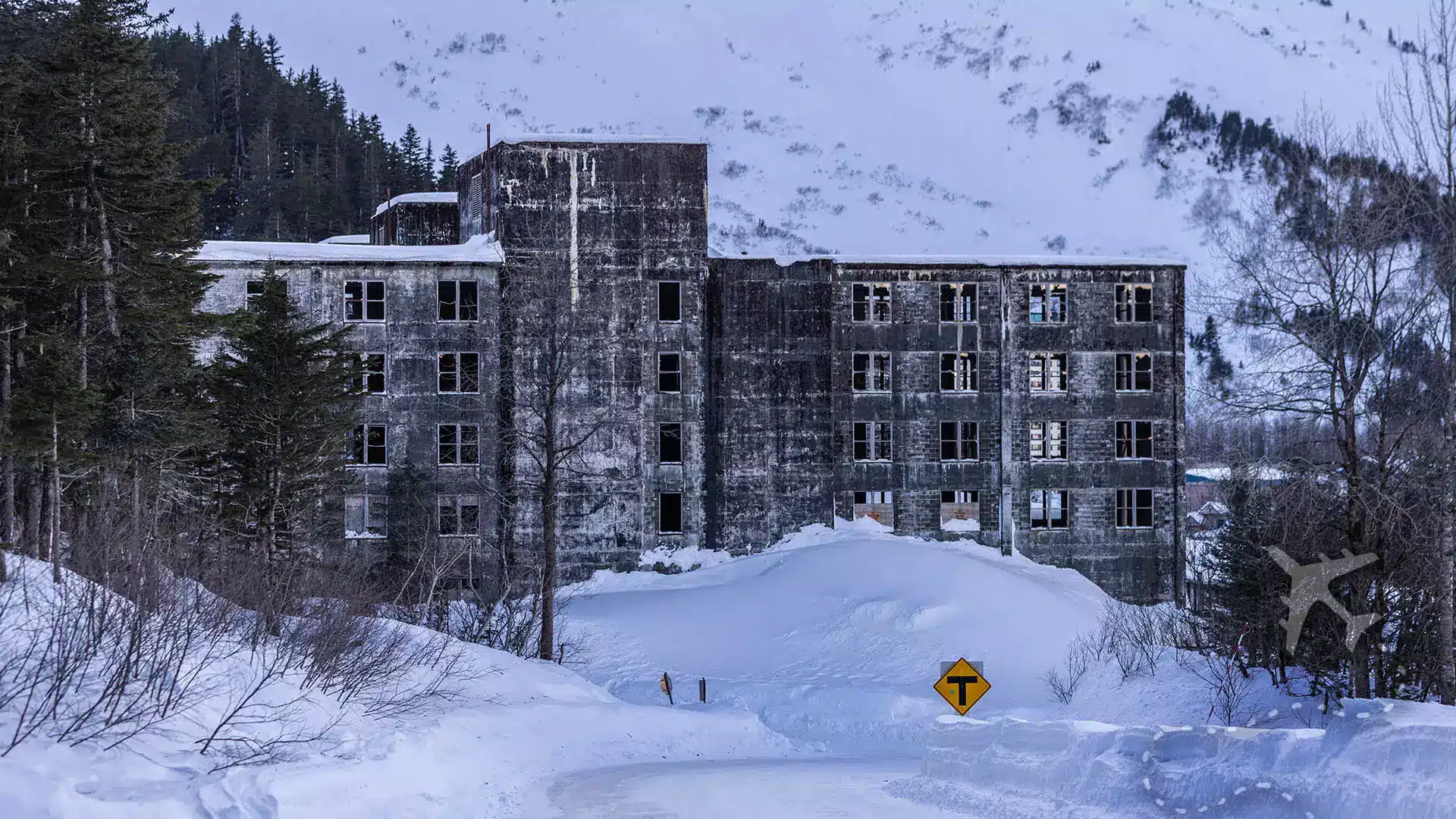
It sits on the edge of town like the enormous concrete corpse of the Cold War, slowly being eaten by Alaska while everyone nearby politely carries on with their day.
Six stories of broken windows, graffiti, exposed concrete and questionable structural integrity.
Naturally, I wanted to see it.
Because apparently when normal people see a collapsing military complex surrounded by fences and warning signs, they think, that looks dangerous.
I think, where should I park?
DESTINATION: Buckner Building Whittier, AK
GPS COORDINATES
60.7748, -148.6742
CLOSEST AIRPORT
CURRENT WEATHER
mist (30F / -1C)

AIR QUALITY INDEX (AQI)
Good (13)
AMERICA BUILT A CITY IN CASE THE SOVIETS SHOWED UP
To understand why someone built this enormous bastard in the middle of nowhere, you have to go back to the early years of the Cold War.
After World War II, Alaska suddenly became extremely important to the United States military for one fairly obvious reason:
Russia is right fucking there.
The possibility of Soviet military action across the North Pacific made Alaska strategically valuable, and Whittier offered something military planners absolutely loved.
Isolation.
Mountains surround the town on nearly every side, while Prince William Sound provides access from the sea. At the time, getting there overland meant traveling through a railroad tunnel blasted directly through Maynard Mountain.
In other words, Whittier was naturally difficult to reach.
Which is inconvenient when you’re a tourist trying to find lunch but considerably more useful when you’re worried about Soviet bombers.
The U.S. Army had already developed Whittier as a military port during World War II, but during the early 1950s it went considerably bigger.
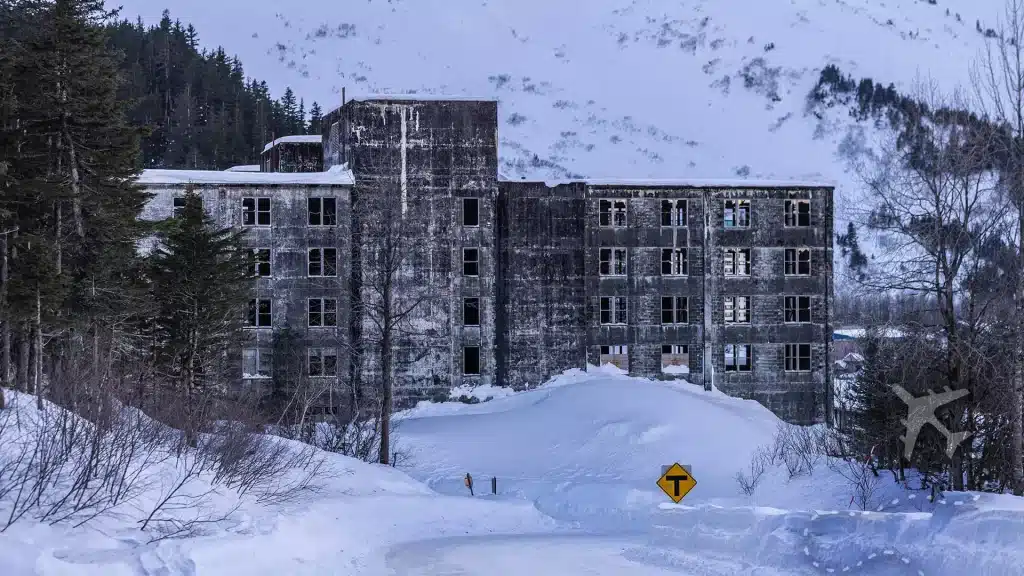
The Buckner Building was completed in 1953.
And “building” doesn’t really describe it.
This thing was basically an entire military installation stuffed inside one gigantic slab of reinforced concrete.
EVERYTHING YOU NEED WITHOUT EVER GOING OUTSIDE
The Buckner Building was designed to accommodate roughly 1,000 military personnel and included just about everything required to keep them functioning without regularly venturing outside.
There were barracks.
Offices.
A cafeteria.
Medical facilities.
A bowling alley.
A movie theater.
A gymnasium.
A post office.
Recreational areas.
Utilities and support infrastructure.
Basically, imagine somebody taking a small American town, folding it several times and shoving the entire thing into a six-story concrete box.
There was a practical reason for this.
Whittier gets absolutely hammered by weather.

Rain, snow, wind and the sort of cold that makes walking across town unnecessarily miserable are normal parts of life here. Consolidating military operations inside enormous buildings meant personnel could work, eat, sleep and entertain themselves without repeatedly fighting Alaska just to get somewhere.
It was called a “city under one roof.”
Which sounds innovative until you realize the city consisted mostly of soldiers trapped together in Alaska during winter.
Thankfully, they had bowling.
THEN THE MILITARY SAID FUCK IT
The Buckner Building’s military career wasn’t particularly long.
Changes in military strategy and logistics gradually reduced Whittier’s importance, and by the 1960s the Army had largely withdrawn from the installation.
That left behind one slight problem.
What the hell do you do with an enormous reinforced-concrete military city in one of the wettest, harshest places in Alaska?
Apparently the answer was: Nothing.
The Buckner Building was abandoned.
And Alaska took over from there.

Decades of rain, snow, freeze-thaw cycles, vandalism and general neglect transformed what had once represented American military engineering into something resembling the headquarters of a particularly underfunded supervillain.
Windows disappeared.
Concrete deteriorated.
Water infiltrated the structure.
Interior spaces were stripped and vandalized.
Graffiti spread across virtually every accessible surface.
Nature slowly started reclaiming everything else.
And somehow, all of that made the building considerably more interesting.
WELCOME TO DARK TOURISM, ALASKA EDITION
I’ve always been fascinated by places humanity built with enormous ambition and then completely abandoned.
The Buckner Building fits perfectly into that particular category of questionable travel decision.

It belongs in the same general universe as Pripyat and Chernobyl, where an entire Soviet city was abandoned after a nuclear disaster, and Centralia, Pennsylvania, where an underground mine fire turned most of a perfectly functional American town into something resembling the opening scene of a horror movie.
These are the places that make dark tourism so fascinating.
Not because they’re abandoned.
Plenty of things are abandoned.
They’re fascinating because someone once believed these places represented the future.
People worked here.
They ate lunch here.
They watched movies here.
They bowled here.
Some poor bastard probably spent Tuesday afternoon in 1957 filling out military paperwork while wondering what was for dinner.
At the time, nobody walking those hallways was thinking:
Someday this place is going to look fucking terrifying.
Yet here we are.
THE BUCKNER BUILDING IS NOT AN URBAN-EXPLORATION PLAYGROUND
Here’s where older travel articles about the Buckner Building tend to become problematic.
They’ll tell you to bring boots.
Pack a flashlight.
Watch for rusty nails.
Explore carefully.
You know, standard advice for casually wandering into a structurally compromised military ruin.
There’s one significantly more important detail:
You shouldn’t be inside the Buckner Building.

The property is restricted, the structure has deteriorated substantially, and entering it can constitute trespassing.
There are also legitimate physical hazards.
Decaying concrete.
Unstable floors.
Standing water.
Falling debris.
Exposed metal.
Dark shafts and openings.
And decades of Alaska methodically attempting to dismantle the building one winter at a time.
I love abandoned places.
I also enjoy having functioning legs.
Fortunately, you don’t need to crawl through a collapsing hallway to appreciate the Buckner Building.
Seeing the exterior is enough to understand the scale of the place.
And the scale is fucking ridiculous.
IT JUST SITS THERE
That’s probably the strangest thing about seeing the Buckner Building in person.
It isn’t hidden deep in the wilderness.
You don’t hike three days through the mountains and dramatically discover it through the fog.
It’s just…
there.
Whittier carries on around it.
Cars drive past.
Boats come and go from the harbor.
Tourists arrive for Prince William Sound cruises.
People go home.
And looming nearby is this enormous Cold War carcass that looks like everyone evacuated approximately fifteen minutes before the zombies arrived.
The contrast is fantastic.
Especially because Whittier itself is one of the strangest towns in America.
DON’T JUST PHOTOGRAPH THE CONCRETE APOCALYPSE
The irony of visiting Whittier for the Buckner Building is that the surrounding landscape is spectacular.
Almost offensively spectacular.
Prince William Sound is filled with mountains, glaciers, waterfalls and wildlife, making Whittier a popular departure point for sightseeing cruises.
Portage Pass offers another perspective, with hiking trails climbing above the surrounding landscape and delivering exactly the sort of ridiculous Alaskan scenery that makes you forget you’re standing near a town containing a decaying Cold War fortress.
So you can spend part of the day contemplating military paranoia and the inevitable collapse of human ambition.
Then go look at glaciers.
Tourism!
WHY PLACES LIKE THIS ARE SO DAMN INTERESTING
The Buckner Building isn’t beautiful.
At least not conventionally.
Nobody is restoring the marble lobby.
There aren’t velvet ropes showing you where Eisenhower once stood.
There isn’t a gift shop selling tasteful Buckner Building Christmas ornaments.
It’s simply deteriorating.

And that’s precisely what makes it fascinating.
The building represents a moment when America looked across the Pacific, saw the Soviet Union and decided one reasonable response was constructing an enormous self-contained military city inside the mountains of Alaska.
Millions of dollars.
Thousands of tons of concrete.
Housing.
Entertainment.
Infrastructure.
Engineering.
Planning.
All designed around a geopolitical reality that eventually changed.
And now the whole thing sits abandoned while moss grows across the concrete.
There is something wonderfully humbling about that.
Humans are extremely good at constructing monuments to permanence.
History is extremely good at proving us wrong.
THE BUCKNER BUILDING DOESN’T NEED GHOST STORIES
Abandoned places inevitably attract ghost stories.
Someone hears footsteps.
Someone sees a shadow.
Someone’s camera battery mysteriously dies.
Apparently ghosts have developed an intense hatred of lithium-ion technology.
But the Buckner Building doesn’t need paranormal bullshit to be creepy.
The actual history is better.
This enormous structure once contained hundreds of people living ordinary lives inside an extraordinary military experiment.
Then the strategic importance disappeared.
The people left.
The lights went out.
And one of the largest buildings in Alaska began slowly collapsing into itself.
That’s creepy enough.
THE CONCRETE GHOST OF WHITTIER
There are prettier things to see in Alaska.
Glaciers.
Mountains.
Wildlife.
Basically the entire state looks like nature got drunk and started showing off.
But the Buckner Building offers something completely different.
It’s a physical reminder that history doesn’t always disappear cleanly.
Sometimes it leaves behind six stories of reinforced concrete.
The Buckner Building was built because America was preparing for a future that never arrived.
Instead of Soviet troops, it got decades of rain, graffiti and tourists pointing cameras at it.
Including me.
And somehow that ending feels appropriate.
Drive through a mountain.
Arrive in one of America’s strangest towns.
Look at the enormous abandoned military fortress slowly dissolving into Alaska.
Take entirely too many photographs of concrete.
Then go look at Prince William Sound and contemplate the fact that eventually nature wins every argument.
The Buckner Building isn’t waiting for the apocalypse.
It already survived one that never happened.




Fascinating! Thank you!